
To be an NCAA Division 1 student-athlete, you need a village. From dieticians to strength trainers to physical therapists, developing and maintaining fitness for elite competition is a collaborative effort. One way that George Mason University Intercollegiate Athletics and the College of Education and Human Development (CEHD) keep our athletes in top form is through evidence-based practices and science. That's where the Patriot Performance Lab comes in.

The Patriot Performance Lab’s role is twofold: They monitor and measure athletes’ health as well as conduct research studies on athlete performance. Over the years, they’ve conducted numerous studies with various D1 teams—such as testing vitamin D levels in basketball players and knee joint adaptations in volleyball players—while providing athletes with critical data on their health metrics like body composition, VO2 Max, strength measurements, and more.

“We’re not just a research lab,” emphasized Margaret Jones, professor in CEHD’s Sport, Recreation, and Tourism Management Division and director of the Patriot Performance Lab. “Providing health services to athletes is also critical. It’s what makes the partnership work.”
Strong science communication skills are essential in this field. Researchers need to be able to translate data and results to coaches and student-athletes so they can adjust and improve. Chris Green, professor of sport management and director of the Center for Sport Management, works with the lab to help staff develop research communication skills.
“It’s relatively new to consider sports management in sports science,” she said. “The field as a whole is starting to ask how we can make good management decisions around athlete health and performance data. But the Patriot Performance Lab is already doing this work. It’s one of the things that makes us unique, and it’s what makes our work impactful.”
Green has been essential, Jones said, in helping lab members develop their communication skills and better understand how information is being shared from researchers to coaches to athletes.
“When they understand why I’m asking them to wear or do something and understand how this will benefit them, they’re more likely to perform at the level required in order for us to get good data,” said Noelle Saine, BS Kinesiology ’22, MS Kinesiology ’23, and a third-year PhD student. Saine, who was herself a student-athlete in track and field, understands the importance of strong communication between sport scientists and athletes.
“It’s establishing trust that what we’re doing will improve their health and performance,” said Jones.

Collaboration with the coaches and athletic trainers is also critical. “We couldn’t do what we do without them,” said Saine. “They see the benefits and importance of what we do.”
Postdoctoral research fellow Erica King, BS in Bioengineering ’21, PhD Bioengineering ’25 and a former student athlete in swim and dive, has been leading the work on knee joint adaptations since she was a graduate student. She led a recent 9-month study using wearable sensors for tracking load during practice, counter-movement jump testing, wearable and clinical ultrasound, MRIs, and surveys to assess the load demands on volleyball players’ knees.
“At the end of the season, we were able to show the coaching staff the average number of jumps athletes complete in a 15-16 week period and the direct effects of that from a joint adaptation standpoint,” she said. “They found that data really helpful, and now they can tailor practice sessions to better support the players and help alleviate strain that could lead to injury.”
Athletes, coaches, and athletic trainers often come to the lab with questions for study and ideas. A blood lactate study with the swim team last spring was requested by the swimmers, who applied for and received an Office of Student Creative Activities and Research (OSCAR) grant to fund the study. The team collected data from blood draws, heart-rate monitors, DEXA scans, and jump testing. Early review suggests athlete stroke specialization and maximal power generation capabilities significantly impact accumulation in blood lactate levels during all-out swim bouts.
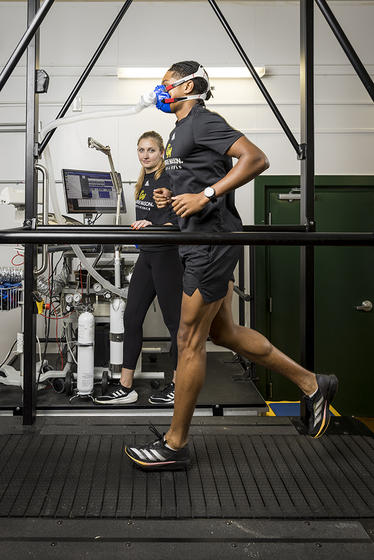
And as Saine and King can attest, the Patriot Performance Lab offers George Mason students the opportunity to do hands-on research in a wide range of fields. There are opportunities for all levels of research, from postdocs like King to high school students interested in exploring this world of research for the first time.
“Having that R1 designation really gives us the extra push to be able to dive deep into research,” said Saine. “Faculty have always encouraged me to find what I’m passionate about and pursue it. And my experience has been that instead of being competitive, everyone wants to work together to push forward and improve.”
Green noted that Jones’ experience as both researcher and practitioner is also an important piece of the puzzle that makes the Patriot Performance Lab work. “[Jones’] capacity to connect all these parts and have both credibility and an understanding of what the needs are sets us apart,” she said.
Jones said she appreciates the openness and willingness of people at George Mason to work together.“We’re supported on both sides by CEHD and Athletics.”
“The Patriot Performance Lab reflects what George Mason does best, bringing research and practice together in service of people,” said Ingrid Guerra-López, dean of CEHD. “Our student-athletes are performing at the highest levels, and they deserve evidence-based support that protects their health and enhances their performance. This partnership between CEHD and Athletics ensures that science goes beyond the lab, to directly improve lives.”
Related news
- March 3, 2026
- February 27, 2026
- February 23, 2026
- February 9, 2026
- February 6, 2026