
 October 15, 2025
Listen up! The Schar School’s new podcast series launches October 15 with two episodes. Learn how to hear them.
 October 14, 2025
First-Year Democracy Lab students were invited to discuss the one and only gubernatorial debate between Winsome Earle-Sears and Abigail Spanberger. Read what their response was and see the replay of the discussion.
 October 14, 2025
Schar School graduate student Zayd Hamid helped organize a hands-on workshop on how to craft a piece of legislation, supervised by Virginia State Senator and Schar School graduate Saddam Salim.
 October 13, 2025
One of, if not the longest-serving adjunct professor reflects on his 47 years teaching government at George Mason University. Meet Administrative Law Judge William Froehlich.
 October 8, 2025
The Schar School’s reputation for teaching and researching international affairs leads to a full membership in the field’s most distinguished organization, the Association of Professional Schools of International Affairs.
-
October 6, 2025
With just weeks to go before Election Day, a new Washington Post-Schar School poll shows one of the candidates with a double-digit lead over her opponent. See who is leading by 12 percentage points.
 October 2, 2025
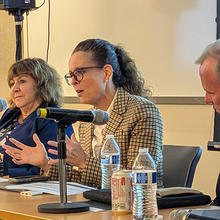
George Mason University’s Schar School of Policy and Government hosted a Constitution Day Forum examining executive power, democratic resilience, and the contested “unitary executive” theory. Featuring Schar School political scientist Jennifer N. Victor, historian Rosemarie Zagarri, and attorney Jonathan S. Massey, the panel addressed constitutional design, judicial oversight, inequality, and the enduring challenges of preserving checks and balances in American governance.
-
October 1, 2025
Two former governors of Virginia faced off in a moderated discussion about Virginia politics and the coming elections. See what Schar School Distinguished Visiting Professors of Practice Bob McDonnell and Terry McAuliffe had to say.
 October 1, 2025
Former governor Bob McDonnell’s lunch at Mason Square offered NSPP students firsthand insights into governance, enriching their fast-track journey to a Master of Public Policy degree.
 September 29, 2025
Nathan Stolzenfeld graduated as an undergraduate with distinction and could have started a meaningful career right away. See why this scholar decided to return for a Master of International Security and Law degree and discover who inspired them.