
Mark Flanigan never set out to build a career defined by borders. Over time, however, teaching and volunteering overseas became the connective thread in a life shaped by service, curiosity, and reinvention.

Eventually, his years abroad led him to graduate study at George Mason University’s Schar School of Policy and Government, where he enrolled in the Peace Operations Program, now a concentration within the Schar School’s top-ranked Master of International Security program.
He graduated in 2006. But before that, the Pittsburgh native served as an Army officer in the 1990s, an experience that left him eager to see more of the world postmilitary.
That impulse carried him first to Mexico, where he earned a teaching certification and taught English at a small private school. It was his first extended period living outside the United States and his introduction to education as a form of cultural exchange—an experience that would quietly redirect his professional life.
Japan followed. Through the Japanese government’s Japan Exchange and Teaching program, Flanigan taught in public schools in Nagasaki, working alongside Japanese teachers to design lessons that paired language instruction with cultural context. What began as a one-year commitment became four.
“It wasn’t just about grammar,” he said. “It was about connection.”
The cohort-based experience at the Schar School, he recalled, was rigorous and serious, yet grounded in practical preparation. For Flanigan, it offered “the best of both worlds,” he said: affordability combined with training for real careers in government, nongovernmental organizations, and international work.
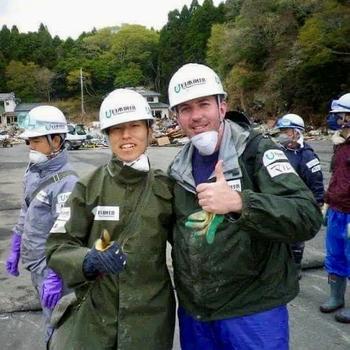
Flanigan credits Schar School faculty and staff with actively guiding students through competitive pathways such as the Presidential Management Fellows (PMF) program, a leadership development program for the U.S. federal government. (The program was terminated last year by the Trump administration.) Selected as a PMF in 2006, Flanigan worked at the Department of Health and Human Services, spent time at the State Department, and ultimately returned to HHS, where his fellowship transitioned into full-time employment.
True to form, he did not stay still for long. Flanigan later returned to Japan, this time for graduate studies in Tokyo, followed by a year of teaching abroad in Bangladesh and a three-year stint in Arizona with AmeriCorps VISTA, before coming back to the East Coast and settling in the Washington, D.C., region.
Today, back in Arlington, Flanigan is once again in the classroom as a substitute teacher, carrying with him a global perspective shaped one lesson—and one country—at a time.
He is also reconnecting with the institution that helped launch his international career as a board member of the Schar School Alumni Chapter. “It’s a great opportunity because I’ve wanted to get reconnected to George Mason,” he said.
Now, as he balances teaching, public service, and alumni engagement, Flanigan’s career comes into focus as a coherent arc—one defined by learning across cultures and giving back wherever he lands. The borders have changed, but the work remains the same: building connection, one classroom at a time.
“George Mason is the best of both worlds,” he said. “A diverse, affordable university that prepares its students to bridge theory and practice while making a real, lasting difference in the world. We need that now, more than ever.”