
Jessye Gassel has always been fascinated with spinning bodies.
“I grew up figure skating,” said physics PhD student at George Mason University. “From 3 years old to 23, I spent all my free time on the ice. And I had a lot of curiosity about how I could do the things I was doing.”
Gassel found herself looking forward to her high school physics class every day and knew, by junior year, that she would pursue it in college. A senior-year astronomy class honed that direction toward astrophysics.

Now she is working with Brian Williams, a research scientist at NASA’s Goddard Space Flight Center in Greenbelt, Maryland, who is also her PhD advisor, and she recently presented a video compilation of Kepler’s Supernova Remnant (SNR) over the course of 25 years and related research at the 247th meeting of the American Astronomical Society in Phoenix, Arizona.
Kepler’s supernova remnant is the result of a Type Ia supernova–a white dwarf star in a binary system that exploded. In fact, it’s a relatively young and nearby celestial object in cosmic terms: only 400 years old and 17,000 light years away. The video was created using data from NASA’s Chandra X-ray Observatory captured over more than two and a half decades.
“Type Ia supernovae are super cool but super rare,” said Gassel. “Cosmologists can actually use the behavior of the remnants to measure the expansion of the universe, and glean more information as to its structure, but there is still much unknown about the details of the actual explosion.”
Kepler’s SNR, she found, is expanding at different rates in different directions. The top is moving at 4 million miles per second (.05% of the speed of light), and the bottom is moving at 13.8 million miles per second (2% of the speed of light). This suggests that the top is expanding into a much denser material than the bottom. Part of what Gassel and her team want to explore next is what, exactly, that material is made of.
“The newest observations of Kepler were taken in summer 2025, and we started putting everything together last November for the January conference,” said Gassel, who has a bachelor’s degree in physics and mathematics from St. Olaf College in Minnesota.
Gassel and Williams previously investigated Tycho’s supernova remnant in 2024 before moving on to Kepler.
The release of the video brought Gassel and Williams—and Kepler—lots of media attention. While publishing papers is standard for researchers, having a NASA press release about your work isn’t, so Gassel said having this opportunity as a doctoral student has been an honor.
“Seeing a news release on the front page of the NASA website with my name attached to it and reading all of the articles that other outlets published about it has given me a major confidence boost,” she said. “Since high school, I’ve struggled with imposter phenomenon as a woman in STEM, so this has truly felt like a ‘I’ve made it’ moment.”
On the doctoral front, Gassel is still putting together her dissertation committee and hasn’t settled on a project yet, although she is pretty sure it will involve supernova remnants and the Chandra X-ray Observatory.

In fact, Gassel named her dog, Chandra, after the telescope that has brought so much meaning to her professional life. Dog Chandra debuted at the Department of Physics and Astronomy’s Halloween party last fall dressed as the Chandra X-ray Observatory and won first prize.
Although Gassel is focused on the stars, she said her terrestrial plans after George Mason include seeking at teaching position and continuing with her research.
Videos: Supernova Remnant Video From NASA's Chandra Is Decades in Making
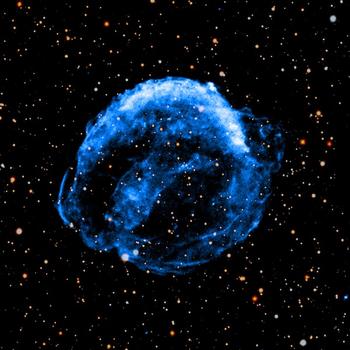
Animation courtesy of NASA’s Chandra X-ray Observatory illustrating the supernova studied in this research.
Related Stories
- February 13, 2026
- February 2, 2026
- August 15, 2025
- July 17, 2025
- July 16, 2025