
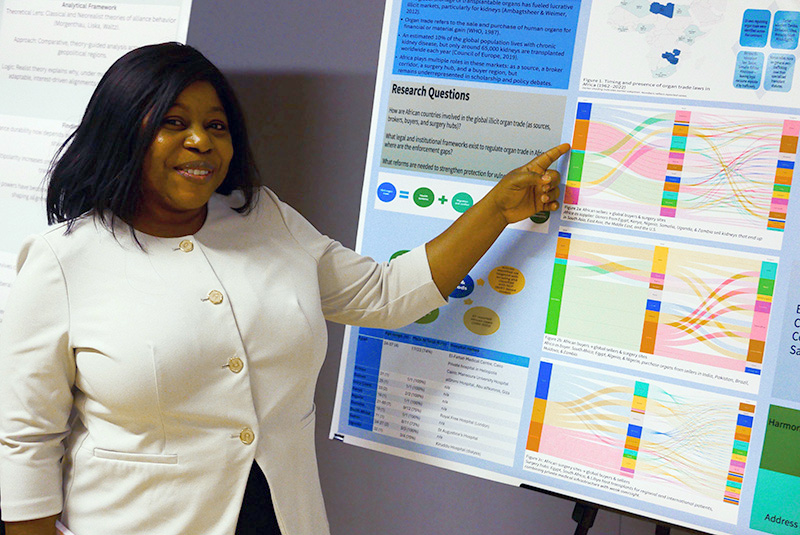
Loveline Phillips’s path to George Mason University has been anything but linear. Born in Nigeria, educated in her homeland and the United Kingdom, and now pursuing a PhD at George Mason’s Schar School of Policy and Government, Phillips carries with her a global perspective shaped by migration, scholarship, and persistence—and, more recently, motherhood.

Her first experience in the United States came in 2017, when she visited from the United Kingdom where she was studying sustainable development on a Commonwealth Shared Scholarship, a fund designed to support students from underserved Commonwealth nations to pursue master’s degrees.
Her then-fiancé was a student at Purdue University in Indiana, which brought her to the United States.
Ever the scholar, Phillips completed one year of a master of philosophy degree in Santa Monica, California, at Pardee RAND Graduate School, an institute within the RAND Corporation, where she deepened her training in policy analysis and research.
From there, she set her sights on a PhD in public policy and applied to the Schar School. Acceptance at the school introduced her to a mentor who would shape her work at George Mason: University Professor Faye Taxman, a health services criminologist and founding director of the Center for Advancing Correctional Excellence, exclamatorily known as ACE!.
The match was not obvious at first. Phillips’s background was in international economic development and health policy, not criminal justice.
“I’d never done anything on criminal justice prior to coming to George Mason,” she said. Still, she leaned on advice instilled by her parents: “Whatever your hands find to do, do it to the best of your ability.”
At the Schar School, Phillips found a way to connect her prior interests with her new field.
“There’s a health and justice nexus,” she said. “These are vulnerable populations that are prone to health challenges and have poor health outcomes.”
Her published work with Taxman examines probation, reentry, and community supervision through both health and justice lenses—a combination she now sees as central to her academic identity.
Phillips credits the Schar School, and Taxman in particular, with accelerating her development as a scholar.
“Prior to joining the Schar School, I never had a first-authored publication,” she said. “And now I have two, with one book chapter coming out soon.”
Taxman, she added, is “my advisor, she’s my dissertation committee chair, she’s a mentor, and she has really pushed me in my career.”
Beyond mentorship, Phillips said the Schar School has given her rigorous methodological training, including using powerful research tools, such as the qualitative data analysis software, ATLAS.ti. That, mixed with her quantitative and social network analysis skills through coursework, results in a valuable mix of method skills, allowing her to approach problems from multiple angles.
“Using both her qualitative skills and system-theory causal loop diagram methods, she has uncovered patterns of how different systems interconnected,” said Taxman. “From this, she identifies how to improve the functioning of systems and organizations.”
Phillips is, she said, “a remarkable graduate student committed to applying the methods she learns at the Schar School of Policy and Government.”
What has surprised Phillips most about the Schar School is its ethos of real-world policy and public service work as well as its collaborative and experiential culture.
“Seeing how faculty is really invested in students’ development stands out,” she said. “The professors are welcoming, they’re warm, hospitable, and they just want to see you excel as a student.”
Balancing doctoral research with life as a parent to a 14-month-old daughter, Tioluwani, Phillips remains focused on the impact of her work. Her next paper looks at how probation conditions impact probationers, especially as they re-enter society, with the goal, she said, of informing both practitioners and researchers for the public good.
In This Story
Related Stories
- January 26, 2026
- July 17, 2025
- South of the Border, Deep in Policy: Study-Abroad Students Tackle U.S.-Mexico Relations in the FieldJuly 7, 2025
- May 22, 2024
- March 18, 2024