
In This Story

Listen to the podcast here:
Welcome to the 15th episode of the show, the official show of the Schar School of Policy and Government at George Mason University. We are talking about something that touches every Virginian. Whether you are sitting in traffic on I-66, working in a data center, or paying your utility bill, namely energy, how we produce it, how we use it, and whether our grid can keep up with explosive growth in data centers, AI, electrification, and population.
Our conversation centers on the new Virginia Energy Report, Policy Roadmap for the Commonwealth, produced by George Mason's Center for Energy Science and Policy. The report warns that Virginia is facing a once-in-a-generation potential energy crisis driven by surging demand, rising costs, and constraints on building new generation.
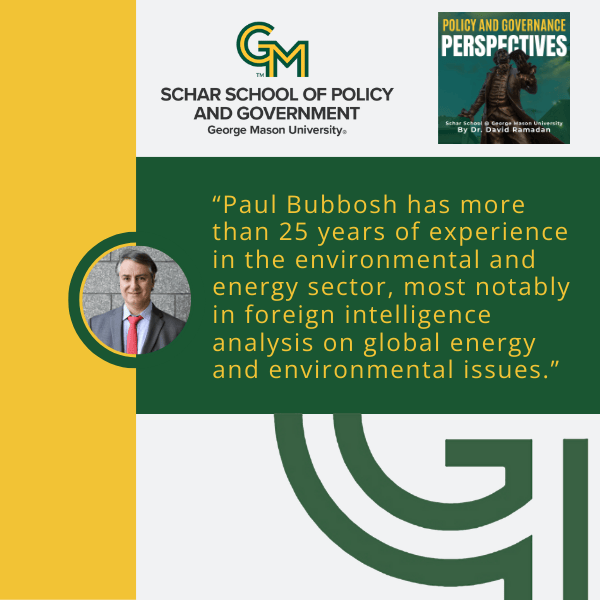
It also lays out practical near-term solutions. I am joined by two of the people behind that work. Paul Anthony Bubbosh, JD, adjunct professor at George Mason University and lead author of the Virginia Energy Report. Paul has more than 25 years of experience in the environmental and energy sector, including thirteen years at the US Environmental Protection Agency and serving as director of the energy security division at the US Department of Energy, where he led foreign intelligence analysis on global energy and environmental issues.
Retired Ambassador Richard Kauzlarich, co-director of the Center for Energy Science and Policy and distinguished visiting professor at the Schar School. He teaches on the geopolitics of energy security and public policy, and previously served as US ambassador to Azerbaijan and to Bosnia and Herzegovina as well as national intelligence officer for Europe. Together, we will break down where Virginia's energy system stands today, what is driving the crunch, and the report's roadmap. From top-down policy tools to bottom-up local action and education to keep the lights on, bills manageable, and the Commonwealth competitive. Gentlemen, welcome.

Thank you, David.
Glad to be here.
Why Virginia Is Currently A Crossroad In Energy
Let us talk in general about why Virginia is at a crossroads in energy. Give us the 30,000-foot view here. Why did you and the team decide Virginia needed this report now? What problem were you trying to solve? Take it from here.
The project began as a classroom project. I teach a class called Energy Law and Policy. In the spring of 2025, the students and I got together, and we decided we needed to do something about Virginia's energy policy. We developed this project and just looked at the various ways energy influences our lives and how our lives, us, influence energy. We looked at those intersections and came up with about a dozen ways.
Things like energy production and consumption, economics and jobs, public health and the environment, infrastructure and technology, and climate change. The list goes on and on. What we did was divide it into chapters, and we assigned students to spend the entire semester digging deep and understanding what the current situation in Virginia under that paradigm is. Understanding that they all intersect, they all influence each other.
At the end of the semester, we had a decent draft. We peeled away about 5 to 6 students who joined the Center for Energy Science and Policy. We continued to work on it throughout the summer until we had a final product in the fall of 2025, and we published it. In a nutshell, what we are trying to address in this report is how Virginia can achieve energy security. By that, what I am really referring to is affordable energy prices, resilient and reliable electricity delivery, and a strong economy and job sector.
Simplify this for us. What do you really mean in simple terms when you say Virginia faces a once-in-a-generation potential energy crisis? What is at risk here? What can go wrong in the next decade?
In simple terms, an energy crisis can mean when demand exceeds supply. It could also mean times of some type of natural disaster, like Hurricane Katrina, where you cannot get energy to flow in and out of your area. In Virginia's case, we have enjoyed an essential equilibrium between demand and supply for over twenty years. That was as far back as we went.
You can probably see that balance continuing further, but we only went back twenty years. Essentially, our generation, our production of energy, and our supply have been in balance. We have been good. Over the past twenty years, our primary energy consumption has dropped a little bit by about a third, which means that we are relying more on getting electricity from neighboring states like Pennsylvania and West Virginia.
That is where we are today, right? We are short about 25% to 30% of our needs in 2026.
Right. When we look at end-use sectors, these are the sectors that consume energy. Historically, transportation has consumed the most for the Commonwealth. Because of the growth of data centers, Virginia, for the first time, had the commercial sector almost tied with the transportation sector. In fact, of all the states in the country, Virginia is ranked sixth nationally in terms of energy consumption from the commercial sector, largely driven by data centers.
This is six behind states like Texas, California, New York, Florida, and Illinois. When this happens, when you have this equilibrium potentially out of balance, you have to make difficult decisions. Historically, in the 1970s, Presidents Nixon, Ford, and Carter faced energy crises, and they had to make very difficult decisions in terms of rationing petroleum.
This resulted in a shortage of fuel, long lines at gas stations, people running out of gas, a spike in inflation, and Congress turning around and passing a slew of energy conservation laws, which are still in existence today. Right now, we are in this situation where we need to either generate more energy, specifically electricity, or find ways to reduce our energy consumption.
I want to be clear, David, I am not suggesting that the lights are going out in the Commonwealth. I do not believe that is going to happen. We are really talking about periods of peak electricity usage, which in Virginia is going to be in the summer months. By crisis, I am referring to really high electricity bills. People are not able to afford to heat or cool their homes.
Let me push back for a second on the high electricity bills. That is not an option. Everything is controlled by the State Corporation Commission in Virginia. They cannot just raise them for the summer unless we are talking about long-term raises. It just does not happen when energy consumption is higher than needed.
I am not sure that is entirely accurate. In Virginia, the utilities can charge the prices they need, and they can go back to the State Corporation Commission and ask that they can recuperate those types of increases and costs from the State Corporation Commission. If Dominion needs to charge more because they need to pay more, they are going to get that cost structure replenished through some type of tariff or rate structure that the State Corporation Commission may or may not agree to, but they are going to probably somehow get their money back.
It has to go through a State Corporation Commission process, and they may or may not be approved. That is not something where we have a higher need this summer, and then all of a sudden electricity is going to go up in July. It just does not work that way.
You are interjecting a question there. I am fine with that.
Unpacking The Virginia Energy Report
Talk to us a little bit about the spiderweb. You mentioned that in your report. Touch one part, and everything else moves. Unpack that for our audience.
The one thing I tell my students is that the energy sector is very complex. There are a lot of moving parts. When, for example, energy prices increase, people have less money to spend on other areas. The cost of heating or cooling a home goes up. The burning of fossil fuels can contribute to climate change, which could exacerbate weather events such as flooding and heat events. Any over-reliance on any one particular technology, even renewables, creates vulnerabilities, for example, in the supply chain.
Energy is one of these public policy issues that really touches on everything else, whether it is the health sector, international security, commodities trading, or what have you. Everything requires energy to move things. The analogy of a spider's web is just to say that when you touch one of these areas, there are reverberations along the way to everything else. An increase in prices, perhaps, has the strongest pull on everything else.
Tweet: Energy is one of those public policy issues that touches on everything else, whether it is health, international security, or anything that requires energy to move things.
Thank you. You mentioned several students who helped you out with those reports. One of them is a mutual student. Jack Potter was one of my students in one of my classes, and he is now working in the General Assembly. He is a huge fan of this report, and he is working for one of our delegates down there. Richard, let me go to you, Mr. Ambassador. From your vantage point as co-director of the Center for Energy Science and Policy, how did this project come together? Who was at the table? What were the disciplines, the students, the partners? Share a story with us.
The most important thing I did was to get out of the way because Paul and his students created what is an outstanding example of the research that the George Mason Schar School is capable of doing. There was no collective decision to do this. It just arose as a natural synthesis of student interest and faculty interest, which is really what has to drive something like this.
The timing of the report was exquisite, I guess is the best way to put it, coming as it did just before the elections in the Commonwealth of Virginia. It is out there as an unmatched study of Virginia's energy situation and something that I think policy makers in Richmond, but also faculty and students here at George Mason, can build upon for the future.
My interest goes back to a conference that we organized last April on AI and the intersection of these issues at the national, state, and local levels. The one thing that is going to be important to address, and Paul has hinted at this, is the shift of electric power from being a commercial transaction to being more of a governance process.

One of the things that we are going to have to be looking at is how you manage the policy alignment at the local, state, and even national level. Also important is making sure that we involve community interest groups in developing the social license that is going to be necessary as we go forward. This is what the center does best, which is provide an environment, even though our resources are limited, to allow studies like this to take place.
David, if I can add one thing. We published the report in November, and I recently looked at what the General Assembly is contemplating in new bills for this session. What I found was that, tracking our report, a considerable number of proposed bills are doing exactly what we are asking the Commonwealth to do.
I am not suggesting that they took our report or were reading it. A lot of what we suggest is really important and resonates with leadership in the General Assembly. We will get into some of these, but one of the things that is the elephant in the room is this idea of the data centers consuming a lot of electricity.
We all agree that electricity consumption is going up. However, one of the most important points we make in our report is that we need to slow that down a bit. We need to think carefully about whether all these data centers are actually going to be able to consume the energy they want to. In other words, is it a speculative type of endeavor for businesses to build this, or are they really going to consume this energy?
You have bills out there, like HB-429 by Delegate Bowling, that talk about accessing reliable modeling software. You have bills like HB-55 by Delegate Thomas talking about getting energy storage access and things of that nature. You have a lot of bills in the General Assembly trying to really clarify the picture as to what the energy needs are moving forward.
The Big Issue Of Powering Data Centers
A former leader in the Virginia House and dear friend of mine used to say, "Take credit when the sun goes up, take credit when the sun comes down." Take credit for it, whether they read the report or they just happen to be thinking on the same page here. That is great news to hear. Let us delve into that a little bit. Data centers are a big issue. The need for energy for data centers is huge.
We are recording on the 30th of January 2026, and I know our audience will not hear this for another ten days or so, but on January 30, 2026, I believe Elon Musk announced that he wants to put data centers in space, whereby you could have continuous solar-powered energy to run them. Interesting. Whether that works or not, I do not know.
I am going to keep his politics out of this show, but the man created a heck of a full self-driving car that I just ordered. There is an issue with data centers in Virginia. They used to be the darlings of Virginia. I live in Loudoun County. Loudoun County is the hub for data centers. They used to be the darlings of any county.
We have the lowest real estate tax in Loudoun in the area because of the income that comes from data centers. They went to a little problem, then became the target. Everybody is attacking them. We saw that in Prince William, where a chair of the board was removed because of support for data centers. We're seeing that across the Commonwealth.
The trajectory here, Paul, is that we are not going to continue to see a growth in data centers, at least in Virginia, the same way we saw in the last ten years. There is still going to be growth, but not at the same rate, and not that huge line going up. Delve into that from what you learned from your reporting and Richard or Paul, whoever wants to jump into this.
Let me just interject here that this is more than data centers. We made a major policy mistake of just focusing on data centers as the challenge, if you will, the capacity limitations in the power sector. We need to think about transportation and manufacturing as well. You're right to identify. That came up in our conference, too, that we've moved from the gee-whiz, where everybody tried to encourage every data center development, thinking this is going to lead to jobs. It turns out it does not take that many people to run a data center. The jobs were on the construction side. We have to focus now on the governance process related to data centers. I think it is a challenge for the future.
Tweet: It does not take that many people to run a data center.
If you're a data center, you look for three things. You look for cheap electricity. That is number one. You are going to go to a place that is going to get cheap electricity to buy. The second thing you look for is existing infrastructure. You want to know if others are there. There is some infrastructure you can move in, you can add, you can build, you can grow.
The other thing is that many of these hyperscalers have goals for clean energy, and so they are going to gravitate towards areas that may have greater use of solar and wind energy in their paradigm of electricity generation. Virginia has those three things, and it has been attractive to many major data center manufacturers.
Whether they decide to go elsewhere, they'll look for those three things in other areas of the country. There is also the potential of political and community backlash, as we are seeing. These all affect data center growth. The real thing on the cutting edge right now is whether or not data centers need to tap into the grid to draw off their electricity.
There is a movement for on-site generation, or collating or having a power purchase agreement with a supplier of energy that is just for themselves. These raise a host of other issues that are worth exploring. Something we could do at our school and in our center. It does suggest that data centers are being responsive to the concerns that have been raised within Virginia.
Rise Of Onsite Generation And Microgrids
On-site generation is an idea that is catching up quite a bit. A couple of years ago, Supervisor Mike Turner in Loudoun County, who is a retired colonel, wrote about a nuclear on-site generation paper that has been spreading around. It seems that this idea, which did not necessarily just come from Supervisor Turner, but from many places, is catching on. Military bases are producing some electricity using mini nuclear facilities.
Two days ago, the Department of Energy issued a request for information inviting the states to express interest in hosting what they're calling Nuclear Life Cycle Innovation Campuses. A new effort to modernize the full nuclear fuel cycle and strengthen America's leadership in advanced nuclear energy. Did you guys look into any of that? The smaller on-site nuclear that the military is looking at, and now what the federal government is trying to partner with the states on?
We did.
I was just going to note that the College of Engineering has a small modular reactor simulation center that was funded by the Commonwealth, but represents technology that the NuScale company has developed. For Mason's future, it is good that we have these engineering hubs that are looking at the technical side. What we need to do is develop some policy presence in this area so that we can help answer these questions of whether it makes sense to either develop power sources that are unique to the data center itself or ensure that if there are power sources, some of that power goes to the broader grid.
I will give a shout-out here to the former director of energy, who was my guest on this show, my former colleague Glenn Davis, who was instrumental in getting that center at Mason funded and up and running. Paul, talk to us a little bit about nuclear on-site, call it for simplicity, mini nuclear on-site energy.
The concept of a microgrid is not new. You can do it with a variety of sources. Small modular nuclear reactors are one potential. It offers independence, and it has traditionally been used for communities, especially rural ones. The idea is to build your own mini plants, supplying your own energy. These are good. They are cost-effective. They are important for infrastructure. Rich alludes to an issue we are going to have moving into the future.
That is, if you start allowing businesses to have power purchase agreements with their own unique deliverer of energy in the form of on-site or some type of localized energy delivery, the question that comes up is, are you removing that from the population? Is a hyperscaler getting that advantage of a small modular nuclear reactor, but no one else? What states and jurisdictions are moving to is, if they're going to approve that, requiring that there be a bidirectional movement of those electrons.
Going to the commercial data center and then in times, being able to flow into the grid. That is going to be a policy decision that is going to be important for the Commonwealth, and one that I would advise that we do. This whole idea of whether we want the data centers connected to the grid or not? It raises a lot of issues. If they're connected to the grid and they are drawing a lot, are they raising prices?
If they're disconnected from the grid and they're isolated, but they have their own energy source, is the larger public losing at that? The middle ground is that there is some type of flexibility where the data center, at times of peak load, can ramp down its energy consumption and allow those electrons to flow back into the grid to help those who need firm energy.
We are talking about hospitals, nursing homes, and areas where we have a vulnerable population. It is this middle ground, this moderate area of saying, "Look, data centers, they are not the bad guy. We need them. We like them. “As you alluded to, David, when they were first introduced, we loved them. We invited them to the community. Now there is this boogeyman image of saying, "They're just going to draw too much energy. They're going to raise costs."
We have got to get away from these extremes, and we have got to find a middle ground that provides practical types of policies. That is what I am alluding to when I am talking about the sharing of electrons back and forth from data centers. The key is to allow flexibility in the movement of these electrons back and forth. The agreements have to be ones where, if you have on-site generation, you have to be able to allow those electrons to go into the electric grid for others to use.
How The Clean Economy Act Could Change Things
I want to talk a little bit about generation. Before we go there, a quick shout-out to Congressman Don Beyer. This is the third discussion on energy on this show. We talked the traditional discussion with Glenn Davis. I also had Congressman Don Beyer, who is a good friend and a Mason student now. We talked about fusion energy. I want to talk a little bit about generation in general, whether you want to include fusion in that or not. Something is opening up in Virginia on fusion, first in the nation. Talk to me about top-down tools. Your report was very clear. You're not picking winners or losers. Is the philosophy all the above at this point? Where are we?
We have a construct we have to work in, and that construct is the Virginia Clean Economy Act. One current bill being proposed is to broaden the definition of what qualifies, and that would be nuclear energy, fusion, fission, and small modular reactors. That will likely pass. The trajectory is dispatchable power, which is fossil and natural gas, are the backbone of energy right now.
The Virginia Clean Economy Act, over time, eliminates dispatchable power. That might be problematic if you do not have reliable renewable energy sources. The inclusion of nuclear is very important because it is going to be highly reliable. The other component to this is energy storage. There is a bill being debated now in the General Assembly to increase energy storage, both short-term and long-term.
If that bill passes, you are going to start to see perhaps greater confidence in renewable energy sources coupled with energy storage as a means to power Virginia's energy sector into the future. Right now, let us not try to hide the fact that coal had an increase of 30% nationally during this cold snap. Natural gas is really the predominant go-to for on-site generation. It behooves us to be practical about these needs. If there is a need to extend the deadlines of the Virginia Clean Economy Act, which is really about 2050, to be 100%. There is a need to extend these deadlines because of the lack of maturation of energy storage. The legislators will address that and extend it.
Is that a question at this point, or is that a reality at this point? Is there a need versus is there a need?
I do not think it is a reality. It is a must-do right now. However, you do want to have a technological midterm evaluation. By that what I mean is that if you're going to say renewable energy, solar, and wind are going to be the future energy sources for electricity in the Commonwealth, you are going to need energy storage. We have verified short-term energy storage capabilities.
Long-term energy storage, 100 hours plus, is something that needs to be developed, demonstrated, and proven to be cost-effective. By doing a technology midterm evaluation, what we are able to do is say, "Look, we are on our way to getting that, or we're not." Depending on the answer to that question, we then move towards maybe extending the Virginia Clean Economy Act for more years.
Thank you. Richard.
It is important to understand that there is a sequencing issue here. Nuclear is not going to solve the short-term or maybe even the medium-term, given the amount of time it takes for the regulatory approval. There is only one small modular reactor design that has the Nuclear Regulatory Commission's good housekeeping seal of approval. It happens to be NuScale.
I was participating in a webinar earlier this week where the discussion was about nuclear, and where the money is likely to go in that sector. Again, you can get different views from different people. It is more likely that money will go to reopening some of the closed nuclear facilities around the country and building data centers close to those. Three Mile Island is one of the examples.
Before we throw Musk's idea out the window, it would be interesting, David, if you had a session with Hina Kazmi, who teaches a course on space policy here, because there are going to be some much longer-term developments that are going to affect AI, energy production, and data centers. We may find ourselves in ten years actually talking about moving data centers into space because we cannot find enough real estate on Earth.
Tweet: We may find ourselves in ten years moving data centers into space because of the lack of real estate on Earth.
Last point, I just made very quickly. I have talked to a counterpart of our center at the University of Texas at Austin. It is interesting to see Texas going through the same process in a way that Virginia is. We need to be very conscious that there is a lot of competition out there for the future of AI and data center development, and we need to be more aware of what other states and other universities are doing.
What The Virginian Leadership Should Do With The Energy Crisis
Bringing it back to earth, whether that is in Texas or in Virginia. This is not just a technical discussion. There is a leadership discussion here, and leadership needs to direct the Commonwealth into a certain policy. Rich, you have seen this internationally. You have experience in the diplomacy and the intelligence world. If we want to bring it not just to Earth but to Virginia, what are we looking for from our leadership here? Before I let you answer, full disclosure. Our new governor in Virginia is a dear friend.
I had the pleasure and honor of supporting her campaign and serving on her transition team. I am proud of the fact that she has decided to include an energy czar in her cabinet. They have not been named yet, but there will be an energy czar to work across the government agencies in Virginia on energy issues. I personally would like to see a Secretary of Energy versus just a czar in Virginia. Besides these moves, are we looking and is there advice that we can send on-air here via our humble show to her excellency, the governor of Virginia, on energy leadership?
Paul, I am not going to try to duplicate what you might come up with in terms of policy recommendations in your work, but it seems to me that we need leadership that recognizes that Virginia has a stake in the future of energy. Whether we're talking about nuclear as we've been or just in terms of understanding the relationship between data centers, artificial intelligence, and energy demand.
Recognizing that and taking it as not necessarily a policy challenge, but really a policy opportunity to build on the assets that are already out there and take advantage of people like Congressman Beyer, who clearly has a vision. It may be long-term, but it is the next step in building that vision into a reality. It can be done at the level of the Commonwealth here.
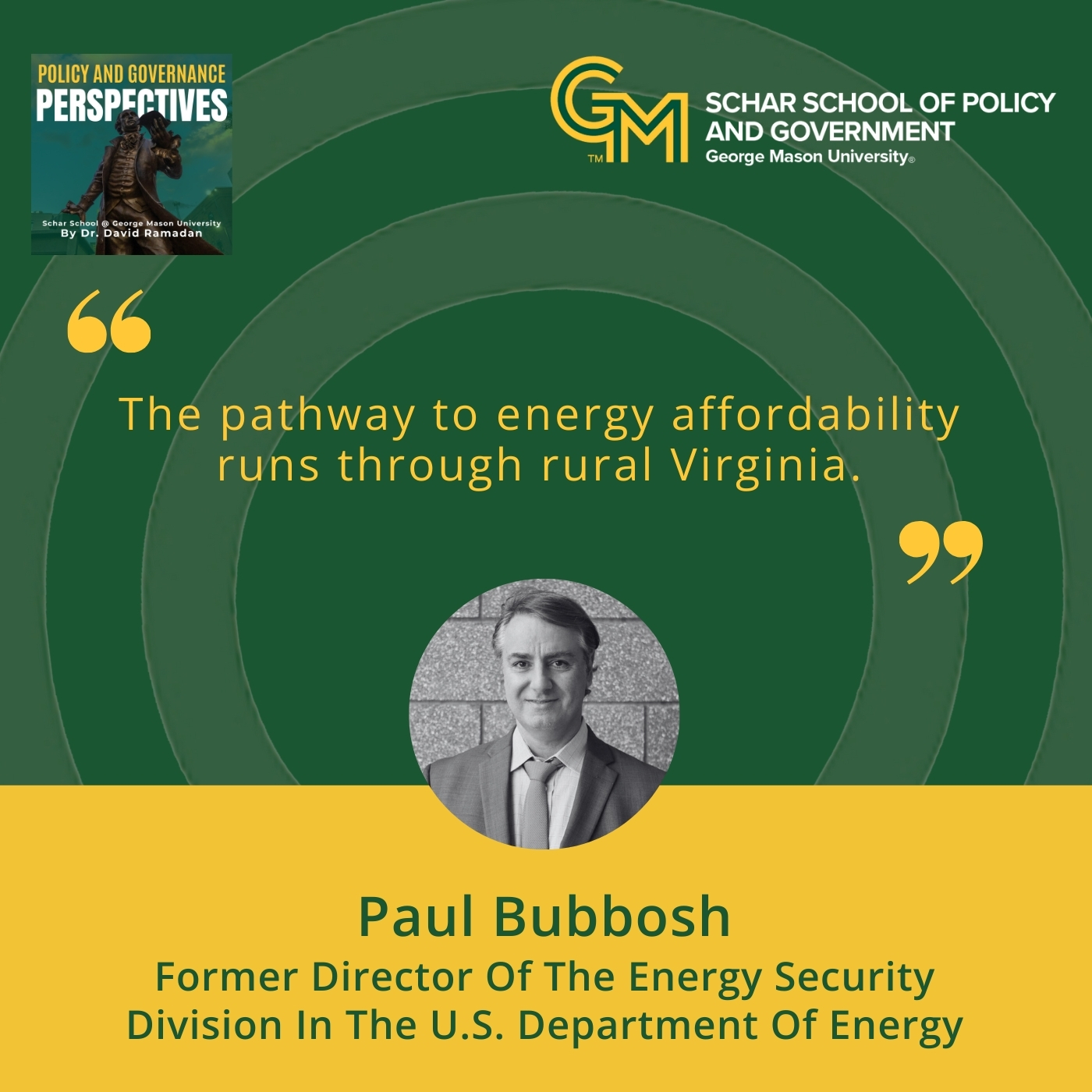
Look, if Governor Spanberger were on this webcast, what I would say to her is the pathway to energy affordability runs through rural Virginia.
Hold on. You just gave a headline for this episode. Say that again. The pathway to energy affordability runs through rural Virginia
It is important because she is the unicorn candidate, a Democrat who did well in rural areas in Virginia. What I mean by that is that not just in Virginia but across the entire country, there has been a disconnect about these issues, and that disconnect runs the rural-urban divide. We are not going to achieve energy affordability unless we bring on rural Virginia and rural America.
Tweet: We will not achieve energy affordability unless we bring on rural Virginia in rural America.
What this means is that if you are going to build large infrastructure projects like solar farms and wind farms, you are going to need a lot of land. That is the one disadvantage of renewable projects is you need a large footprint. This requires building projects where there is a lot of land. Those are the rural areas. You need to construct a connectivity between those rural areas running through other rural areas before you essentially get to an urban area that is consuming a lot of data or a data center that is consuming a lot of data.
Right now, rural centers and rural areas do not like renewable energy projects. Within the Commonwealth of Virginia, there are about 120 municipalities. Forty years have passed since the bans on solar-type projects. This is a serious problem. One of the mistakes that happens is you're a top official, and the first thing you do is you say, "I want to control permitting and siting. We're just going to legislate by fiat, top-down, that we're going to build these projects."
That is a huge mistake. One of the advantages of working at a university like George Mason University is that we've had projects in rural areas. We've gone to what is referred to as Southside. We went to Henry County, the City of Martinsville, and the City of Danville. We brought students in, and we worked closely with community leaders and local government.
We sat down with them over the course of a year, and we said, "How can we make this work? How can we build an energy action plan for you?" During the course of that engagement, there was a lot of trust. We built up a lot of trust. They achieved a lot of confidence in what we were providing them, and they all three adopted an energy action plan. That is unheard of in conservative areas throughout the country. The way we did it is building that trust relationship.
When I say that I had the opportunity to talk to leadership in Virginia, I would say, “You need to go slowly in rural Virginia, and the way you do it is you work with municipalities in building an energy action plan that fits their needs.” This cannot be a top-down type of fiat legislative act. What we did working with someone like Henry County is we looked at what they want. What is it they need? What are their economics? What is their culture? What is their history?
They may not like the unsightly look of solar panels. How far back would they like to have them set back? What is the community saying? Not just the loudest voices, but representatives throughout the community. What is it they want? The disadvantage to this, David and Rich, is that it takes time. We may not have time.
Do we have that time? That is the question.
Right. What we've seen, however, is in pendulum politics and the fact that the Virginia governorship is for four years. If you do not build a solid foundation, it is going to be taken out from underneath you if the administration changes. We saw that going from the Biden administration's Inflation Reduction Act to the Trump administration's One Beautiful Bill Act.
The complete reversal of policies in the area of energy. If you want to avoid that happening, you need to bring in rural Virginia and rural America. The way you do that is you listen to them, and you try to meet them where they are. What are their needs? Otherwise, you lose an enormous amount of credibility in anything you are trying to do.
I am glad to hear about that Southside initiative and projects. I need to connect you with Senator Bill Stanley from that area, a dear friend of mine who has a racing podcast. He talks quite a bit about racing cars, and he is a state senator representing that area. I am sure there will be quite a bit of education that he would love to talk to you about regarding energy, especially with those initiatives. Those are the initiatives that you call the local energy action planning initiatives in your report. Is that what you are talking about for cities and counties?
That is right.
How George Mason Can Raise Awareness About Energy
We are getting towards the end of our time here. I could talk about this stuff for another hour, but let us bring it down because you alluded to this, and this is open to both of you, Rich and Paul, for the last couple of minutes, on the bottom up basically. That is what you're talking about. Instead of a top-down policy, it is a bottom-up start with the local. Now, let us bring it up to Northern Virginia and to Mason.
What is our role here, as George Mason in particular? I am going to talk on the policy side and in the Schar School, since this is the Schar School's show. Our friends in the engineering school can do their own. On the Schar School side, what is our bottom-up role? How can our students engage, and in particular, engage with our local surroundings, which are Loudoun, Fairfax, Arlington, Alexandria, and so on?
Part of it does, in fact, involve other departments and schools here at Mason. We are not going to be able to do this alone as simply a standalone policy approach. Building connections with the College of Engineering, in particular, on their existing centers and the desire to do more as Schar in the nuclear area would be one way of advancing these interests from the bottom up.
One thing that Schar can do is to begin to identify what the stakeholder groups in this process are. Paul has mentioned the pathway being through the rural areas and community interest groups, but somehow we have to bring together the utilities, the state regulators, the data center developers, and the interests in terms of academic research that George Mason can provide.

We need to be very clear. If we do not begin to offer more opportunities for certificates and traditional teaching and training opportunities here at the university, we are never going to be able to do much more than we have done already. There needs to be a boost in terms of leadership interest at the Schar School in energy, in particular, in how it plays out across a multitude of disciplines.
Let me add one international aspect that is really important, and that is watching what the Chinese are doing. China is obviously a different situation and a different environment, but they are facing many of the same challenges that Paul identified in his report. I do not think we know enough about their success or failure rate to be able to make any judgments about whether they found the answers, but I think that is something else that Schar could look into.
David, we're educators. That is our chosen career at this point. The one thing I would like to see us do as a policy school is to actually formalize a curriculum on energy security. We do not have one. We have got Rich's class, we have got my class, and that is about it. If you developed a concentration on energy security, you are addressing one of the most important issues, not just in Virginia but across the country is energy.
Tweet: If you develop a concentration on energy security, you are addressing one of the most important issues not just in Virginia but across the country.
Energy and climate change as well. You can use buzzwords like affordability. You can do whatever you want. It all comes down to energy security. A curriculum around energy security, talking not just about law and policy but engineering and the infrastructure and the public health benefit. You just go through the table of contents in the report that we wrote, and you can come up with entire classes.
There are some schools that excel in this area that understand that students studying energy security are very well-prepared to enter a variety of interdisciplinary professions. I dream that the Schar School takes a leadership position in the area of energy security, develops a concentration or some type of focus area that says, “Look, energy is important. It is going to affect all the other public policy focus areas.” We want students to walk out of here understanding these issues.
Energy is important. Almost everything we do is dependent on it. Paul, Ambassador, thank you both for your leadership and for helping us make sense of Virginia's energy crossroads. For our audience who want to go deeper, you can read the full Virginia Energy Report: Policy Roadmap for the Commonwealth and learn more about the Center for Energy Science and Policy at George Mason University by visiting our Schar School website and this show’s website.
There will be a link there. You can find this episode and all previous episodes of Policy and Governance Perspectives at Schar.GMU.edu/podcast or wherever you get your podcasts. I am David Ramadan, and this has been Policy and Governance Perspectives. Until next time, stay informed, stay engaged, and do not forget, energy policy is not abstract. It is your bill. It is your job. It is your future. Until next week.
Important Links
- Paul Anthony Bubbosh on LinkedIn
- Richard Kauzlarich on LinkedIn
- Virginia Energy Report: Policy Roadmap for the Commonwealth
- Policy and Governance Perspectives Podcast
About Richard Kauzlarich

Ambassador (ret) Kauzlarich is Co-Director of the Center for Energy Science and Policy (CESP) and Distinguished Visiting Professor at George Mason’s Schar School. From 2003 until 2011, he was National Intelligence Officer for Europe at the National Intelligence Council. He was Director of the Special Initiative on the Muslim World at the United States Institute of Peace following a 32-year career in the Foreign Service.
He served as United States Ambassador to Bosnia and Herzegovina, and to Azerbaijan. He also was Senior Deputy to the Secretary of State’s and the President’s Special Representative to the Newly Independent States. Ambassador Kauzlarich received his A.A. from Black Hawk College, B.A. from Valparaiso University, and M.A.s from Indiana University and the University of Michigan.
About Paul Bubbosh

Paul Bubbosh has 25 years of experience working in the environmental and energy sector, across law and policy. He served as the Director of the Energy Security Division in the U.S. Department of Energy. In this capacity, he spent eight years leading foreign intelligence analysis on global energy and environmental issues. Prior to his service in DOE, he spent 13 years in the U.S. Environmental Protection Agency, where he worked in the Offices of Transportation and Air Quality, Radiation and Indoor Air, Enforcement and Compliance Assurance, and in the Office of the Assistant Administrator for Air and Radiation. His publications range from several Presidential Daily Briefs, air quality guidance, and energy action plans.
He served as an environmental legal advisor in the U.S. Peace Corps serving in Costa Rica for two years. He also worked in The Nature Conservancy conducting legal analysis of Central American environmental laws. Locally, he spent five years as chair of the Montgomery County Energy and Air Quality Advisory Committee and he clerked for the Honorable F. Bruce Bach of the 19th Judicial Circuit in Virginia (Fairfax Circuit Court).
As an educator, he has taught or developed courses on environmental law, energy law and policy, environmental security, and energy and society. His teaching and research interests involve experiential learning, active learning strategies, and authentic assessments.