
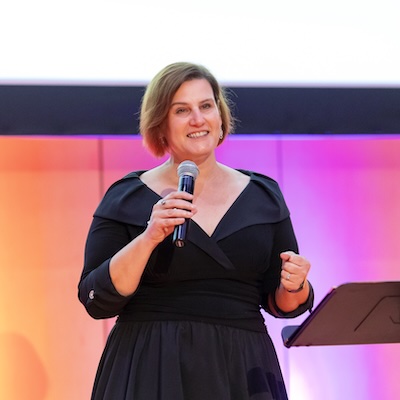
The leadership of our Executive Board is a vital asset to the success of the Hylton Center. Their guidance and strategic insight strengthen the Hylton’s mission and help the organization thrive. We are excited to introduce the Chair of the Hylton Performing Arts Center Executive Board, Joyce Connery, who has served on the Hylton Center Board and Board Committees for eight years, and assumed her current role as Executive Board Chair in July 2025. Connery, who currently owns and operates her own consulting firm, Connery Strategies, retired from the federal government after over 23 years of service. Her last federal position was Chair of the Defense Nuclear Facilities Safety Board, a position she held for two terms, appointed first by President Obama in 2015, and then by President Biden in 2021. The Defense Nuclear Facilities Safety Board is an independent organization within the Executive Branch, chartered with the responsibility of providing recommendations and advice on public health and safety issues at the Department of Energy Defense Nuclear Facilities.
Connery’s distinguished career is recognized by an impressive array of accolades and awards. She holds a bachelor’s degree in International Relations from Tufts University and a Master of Arts in Law and Diplomacy from the Fletcher School, and is a 2017 Graduate of the University of Virginia’s Sorensen Public Leadership Program. She also received a Master’s in Social Work from George Mason University in 2023. Her awards include: Secretary of Energy’s Distinguished Service Award, finalist for the 2012 Service to America Medal for National Security and International Relations, a Presidential Citation from the American Nuclear Society, and a Meritorious Achievement Award from the Nuclear Infrastructure Council.
We invited Connery to share insight into her leadership style and vision for the Hylton Center.
You’ve navigated worlds from entrepreneurship and government employment to advocacy and volunteerism. Which key leadership skills proved most critical in balancing these distinct roles, and what did you find uniquely inspiring about guiding work across such varied sectors?
Connery: While the “venues” have been distinct, I would say that the attributes or skillsets one needs are very similar in any leadership role. Having a passion for the mission is necessary but not sufficient. You also need a vision of where you want the organization to go…and you need to be able to quickly pivot that vision based on external circumstances, without compromising the vision. What I learned through my career is mission first, people always. You will move on from whatever position you hold, and you'll want to steward the organization during your tenure, but also set the next person or team up for success. I believe the best leaders allow the individuals within the organization to shine. Everyone comes to the table with different gifts. In the orchestra, you have your strings, your percussion, your brass…and the conductor brings out each of their talents and together they make music. And a guest conductor or your successor should be able to step in and perhaps add their own uniqueness but still create wonderful music.
I am inspired by the human spirit in whatever sector I am working—whether it is nuclear science, social work, or the arts. And regardless of where you are in the world, the languages of science, and of art, and of humanity are all the same.
Having been such a vital part of the Hylton Center's success, how did you decide to take on roles with the Board and Committees? And for those who don't know, how would you compare the experience and expectations of serving on the Board versus a Committee?
C: My predecessor on the Board was Rick Smith, and he introduced me to the Hylton and to the Board. He was very involved in the arts through ballet. My first artistic love was the theater and so to be a part of a performing arts center was intriguing, but MORE intriguing was a venue that involved arts and the community and education in a way that makes the arts accessible. On the Board, I got involved in audience development because I loved the idea of bringing more people into the arts and connecting the community that way. I think I have served on almost all the committees save finance—because spreadsheets are my kryptonite. The Board is like the conductor that I mentioned—it should set out vision and goals for the organization whereas the committees are the various orchestral sections—each necessary for the symphony but each is also closer to the details of their parts.
When you consider your support, what is it about the arts that personally inspires you to give your time and resources? And strategically, what do you believe is the most essential way that the performing arts elevates and changes our community?
C: Not to be too wonky and quote Picasso, but I think he put it well, “Art washes away from the soul the dust of everyday life.” Whether visual or performing arts, the audience experiences the world for a period of time, through the lens of the artist’s eyes. It offers an opportunity to experience empathy and creates space introspection at the same time. And performing arts are non-replicable. Every member of the audience has both a personal and a collective experience that only exists during that one performance.
Thinking about the full spectrum of our work, from mainstage shows to community outreach, which performance or initiative do you feel best exemplifies the Hylton Center’s unique value and mission in the community?
C: The educational programming and the Veterans and the Arts programs exponentially expand the impact of the Hylton Center. Participants not only enjoy performances but they can tap into their own creative impulses and create connections and forge communities that endure outside of the confines of the programs themselves. I met a Hylton volunteer whose daughter danced on the stage at Merchant Hall as a student and thus created a lifelong connection with the Hylton Center. The testimonials of the Veterans who participate in the Veterans and the Arts program describe lives and relationships that have grown and changed because of it. Sometimes, just having something to look forward to can have a profound impact on how one moves through the day.
What is the one essential, special quality about the Hylton Center that you feel the community needs to hear?
C: I think that the Hylton is accessible in every way…and I don’t just mean free parking. Ticket prices are kept low and students can almost always attend without charge. Those with mobility issues can be accommodated, there is now closed captioning, and the children’s programs often have a special sensory friendly program. And the performances are accessible and often have pre-event curtain discussions with the artists or about the performances. The staff does a wonderful job of picking artists and performers with wide appeal. The space itself is beautiful and inviting. It says, “you belong here.”
If your life were adapted into a musical, which performer, living or historical, would you cast to play you on stage?
C: Really? Well, I have always wanted Neil Patrick Harris to NARRATE my life in song…but as to which performer? I would have to go with Little Nell (Nell Campbell). My only foray on the stage was in the Harvard Square’s Fully Body Cast live midnight performance of Rocky Horror and I played Columbia (Little Nell’s role) on Friday and Saturday nights when I wasn’t waitressing through my first two years of university. The actress herself was scrappy, a little risqué, and made me want to learn to tap dance!
The Hylton Center is grateful for Connery’s extraordinary leadership on the Executive Board in shaping a future where the arts remain accessible, inspiring, and deeply connected to our community. Visit our website for a full list of Hylton Center Board and Committee members.