
Virginia is currently facing a number of energy issues, particularly with the rising costs and an increasing inability to meet consumer and climate demands. David Ramadan and guest co-host Dr. Michael Webb unpack how to take care of these problems before it is too late with Hon. Glenn Davis, Director of the Virginia Department of Energy. Together, they discuss how energy is produced, regulated, and distributed, highlighting the role of PJM Interconnection in running the entire power grid. They also break down how bipartisan politics is affecting energy policies and why fusion reactors could be the next big thing for energy production.
Listen to the podcast here:
Addressing Virginia’s Energy Issues With Hon. Glenn Davis & Dr. Michael Webb
In this episode, we're diving into energy, who produces it, who uses it, who regulates it, and what Virginia energy future looks like in a rapidly shifting landscape. My guest is my dear friend and former Virginia House of Delegates colleague, the Honorable Glenn Davis, now director of the Virginia Department of Energy and a longtime public servant. He is leading the implementation of Virginia's All American, all of the above energy plan.
Joining me as co-host is also a dear friend, Dr. Michael Webb, Vice President of REG LLC. Michael is both a scholar and a practitioner in the energy sector with over 25 years of experience spanning regulatory, academic and corporate arenas. He also serves as an Adjunct Professor here at George Mason, where he teaches Economics, Energy Policy and Regulation. Together, we'll unpack how energy moves from the ground to the grid in Virginia, the major challenges ahead, and the practical opportunities we can pursue no matter which party controls Richmond. Gentlemen, welcome.
David, thanks for having me.
How Energy Is Generated And Distributed In Virginia
Thank you for being here. All right, let's jump right in. Director Davis, explain to us, please give us an energy 101. Help us start with the basics. For the average Virginian, where does our energy come from? Who generates it, who regulates it, and how does it actually get to homes and businesses?
David, that's a long and loaded question. Virginia Energy and the Commonwealth oversees everything from mining, for thermal coal, and met coal in Southwest Virginia in one of our offices to the critical minerals, my geologist out of Charlottesville, and then the office the state energy office in Richmond, which oversees technologies, solar, wind, nuclear, etc.

All that comes together to create all those different areas come together to create power for Virginia. Whether it's the coal mines in Southwest Virginia that more in the decades in past would create your mind for thermal coal, and coal was such a large producer of power back then for the Commonwealth of Virginia, and we exported a lot of it as well. Now, 55% of all of our power is by natural gas. Over 30% is by nuclear.
It's single digits when you start talking renewables, solar and wind. All that is generated and is generated by a number of entities. First, obviously, our utilities. Virginia has two large investor-owned utilities. We call them IOUs in Virginia, Dominion Power. Out in the Southwest part of Virginia, you have APCO, also, the parent company is AEP.
We also have a number of cooperatives. Cooperatives are entities that are member-owned, and there are a number of those in the Commonwealth wealth as well that provide power for their members and residents in those areas. The majority of power is produced by the IOUs. There are only two coal plants left in Virginia right now, but through the nuclear facilities, four of them. Two of them are in Surry, two of them are in North Anna. Obviously, natural gas around the Commonwealth.
What a lot of people don't realize is that Virginia imports 35% of all of its power now. A large chunk of that actually comes from West Virginia. When you look at West Virginia, Dominion actually has coal plants that provide power to Virginia, which will be interesting in the later conversation I'm sure we're going to have. The last thing I’ll mention, David, my life was a lot easier when I thought Virginia existed in a vacuum, when you and I were in the House of Delegates before I knew this term. PJM.
PJM is a regional transmission operator, 13 states in the District of Columbia, pretty much a small portion of North Carolina and then 13 states go in the North. Their job is to balance all the electrons on the grid to keep the lights on. To that extent, Virginia does not control its own destiny. We're part of a much larger grid and decisions made by other states impacts the reliability and affordability in the Commonwealth of Virginia.

A quick follow-up, if I understood it correctly, we are literally using all the above now. We have nuclear power generation, we have gas generation, we have natural gas, we have still some coal in Southwest Virginia. We have some renewables, but they're minimum. Yet, even though we got all of that production in Virginia, we're still 35% short.
Yes, and growing. To put it in perspective, David, we can talk about expectations and where they were in 2020 and where they've grown to now, but we expect to have to double our energy supply in the Commonwealth of Virginia over the next 10 years. Essentially, we use about 25 gigawatts now, and we need to be closer to 50 gigawatts by this coming next 10 years.
That's because that's what the demand is in the market. Is that mostly commercial, or is that both commercial and residential?
It's a mix. It is mostly commercial. Back in 2020, Dave, when you and I were in the House of Delegates, and for a long time prior, we had more people leaving Virginia than coming to Virginia. Masses of exports. Now we're having more people coming to Virginia than leaving Virginia. We are seeing greater growth on the residential side, but residential is a small piece of the equation.
Where residents has a bigger impact is when people start electrifying. When people start having electric cars and they're charging at their homes and more what we call internet of things, the number of devices in their home that run our electricity now is an enormous multiple of what they were back twenty years ago.
Tweet: Virginia does not control its own energy distribution. It is a part of a much larger grid, and decisions made by other states impact its power reliability and affordability.
When we look at the majority of this demand is because the onshoring of advanced manufacturing, again, and a lot of that's coming to Virginia, you've seen the investment of over $140 billion of new investment over the last three years or so in the Commonwealth. Data centers. We knew data centers were growing in Virginia, but AI uses a lot more power than a traditional data center. The simple things, David, that we don't think of using a lot of power like indoor agriculture, that uses actually a lot of power as well. All that coming together is increasing the demand significantly.
Even though it's not the topic now, but we may see more need for the marijuana growing as well coming in.
I would imagine this to be a conversation soon.
Michael, I’ll turn it to you.
I actually had a conversation with somebody growing legal marijuana and the electricity implications. Glenn, we've touched on this, but how has this energy mix evolved over the last twenty years, coal, nuclear renewables, natural gas, and how do we compare to other states in terms of generation usage and costs?
We are more expensive than the states South of us, when you start looking at South Carolina and North Carolina. When you look at the standard cost of electrons power, people can have that conversation of, are we more or less expensive? However, you then throw on the rider on top of it and the racks. When you look at an all in number, that's where we start having some of the competitiveness situations.
We still are less expensive than the deregulated states to the Northeast, so we're still doing well there. There are some challenges when it comes to competing against states like North Carolina, South Carolina, Georgia, the states that we're known to compete with a lot for economic opportunities. Also, it's not just the cost anymore. It is reliability. Virginia imports 35% of all its power, and it's not just Virginia, but we have been transitioning, since 2020, away from coal.
The Virginia Clean Economy Act is forcing us to transition away from natural gas. Now, by law, that 55% of power in the Commonwealth of Virginia, I mentioned, has to be eliminated by 2045 and the Dominion area territory, so Eastern Virginia, and then by 2050 in the Western part of Virginia. How are we going to replace 55% of all of our power with solar and wind? Due to that, PJM has come out and said that the states that are importing power are not going to be able to import as much as they've been importing in the past.
It will be a risk of rolling blackouts in 4 to 7 years from now because of this because states have gotten rid of what we call baseload power, power that comes on when you need it. Natural gas, coal, nuclear, those are your base load power. It doesn't matter if the wind's blowing or the sun's shining, and retired plants and other states have as well. They brought on intermittent power, which although does give off electrons, is not as reliable because it's the wind's going to blow, the sun's got to shine, that sort of thing. It's causing some reliability issues inside of our grid.
How Energy Storage Can Transform Energy Production
To follow up on that, I think probably all of us know this, but for somebody who isn't living power day and night, what is the importance of balancing electrons and reliability? If I turned on my lights when I walked into my office, when were the electrons that are powering those lights produced?
It's interesting. When you look at the power, and we have a great grid, but it shows the power generation of Commonwealth of Virginia. It very much follows the natural transitions of the sun because we have so much cellular in Virginia. At the very end, what we call peak demand is 4:00 to 8:00 PM pretty much in a day.
As the sun's going down, that demand goes up the highest. That's because people are coming home, they're washing their dishwasher, they're charging their car, they're washing clothes, they're turning on the lights, they're watching TV, they're on their computer. All that stuff has now thrown it through the roof, which is why when we talk about where we need electrons and what timeframes we need to matter to the grid, it's that 4:00 to 8:00 PM.
When you talk about electricity costs going up, and do we need to build more power, it's because you don't build based on how much power you use over the course of the year. You build on how much power you need at any one point in time. That point in time happens to be the coldest of cold days, hottest of hot days between 4:00 and 8:00 PM.
Why don't you just produce more power on a balmy day and save it? If I'm going to produce Coca-Cola, I can put it in my warehouse. Why don't I produce on an ice day and save it for a cold day?
That's where we look at innovation's going to come and truly disrupt some things and add that. That's where energy storage comes into play. There are so many different types of energy storage. You've got hydrogen. Most people talk about battery storage, but you've got hydrogen as a way we can store energy. You've got some gravity-type scenarios where we can store energy.
Pump storage?
Yeah. Pump storage. It's great to be able to have that, and that's coming a long way. As we get longer term battery storage or energy storage, that's going to allow us to basically shift that peak curve because we'll be able to provide that power when we need it. That power could come from natural gas or it could come from the sun. That's really going to help quite a bit.
Now, we don't have the technology to store in commercial quantities.
Not in the ways we do now. We have four-hour batteries that are out there commercially, and that is fine. You're talking about something where is truly going to help us push the curve. I look at Vermont. Vermont had a great model, and I wanted to do it in Virginia, but our utilities, the population in Dominion territory, it's a lot more population in an area.
Vermont said, “Instead of us going out and building more power generation resources, it is cheaper to send all the residents of four-hour battery in this utilities area and let the utilities control them.” That's what they did. Instead of building new power generation, they just sent everyone installed a four-hour battery that the utility controls. In peak hours, it actually uses those batteries to decrease the energy demand on the grid to prevent them from having to build more power generation. We talk about things like microgrids, which are very similar scenarios on a bigger, larger scale that will also help things like that as well.
Breaking Down The Role of The Department Of Energy
Let me take it back to you, Director Davis. Talk to us a little bit about the role of the Department of Energy, the role of the director of the department, and then what does Virginia Energy do or not do within this picture?

The department basically crafts the energy policy for the administration. We oversee the energy plan for the Commonwealth of Virginia and its implementation. We draft in conjunction with a couple of our agencies the energy security plan, which is different from the energy plan. The energy security plan is what happens significant disaster situation. Can our hospitals still stay online? Can our public safety still stay online? Are we properly protected from cybersecurity threats? That sort of thing.
We oversee the permitting of the mines out in Southwest Virginia. We oversee safety of the mines. We have safety teams. We also oversee the mapping and hopefully, identification of critical minerals around the Commonwealth of Virginia, that commercial entities may want to come in mind. We also are the experts for the Commonwealth when it comes to energy technology and helping to give guidance advice on policies or directions.
I have a number of phds in my office. I have experts on everything from nuclear to wind to gas to solar, that we're able to help provide the legislature and the administration guidance and expertise on those. Lastly, I would say, David, our job is also to go help spread Virginia's message that we are a leader in energy, bring a lot of interest, hopefully economic interest into the commonwealth.
My job as the director, I am a government gubernatorial appointee, so I serve at the pleasure of the governor, and my job is to oversee the department. I have an amazing team. When I came in, as you'd imagine, David, I had a large learning curve. I jumped out really quick. An amazing team helped with that. My job is to jump into the middle of it.
I make sure that we have tremendous efficiency expertise, good teams to do the job that we're supposed to do. I do get involved just because of my background, David, in a lot of economic development opportunities, I get into the weeds of certain types of energy development, mainly nuclear at this point, and trying to bring that first of a kind to the Commonwealth. David, I'm sorry, you had a third part in there and I forgot what that part was.
What is it that Virginia energy is not doing and could do?
We actually do not regulate energy. If it's nuclear, it's to federal level. You've got the NRC up there. When it comes to gas and you're taking gas across lines, you've got FERC. When it comes to environmental scenarios, we have a Department of Environmental Quality in Virginia that oversees that. We actually don't oversee the actual development and permitting of energy in the Commonwealth.
Top Energy-Related Challenges In Virginia In The Next Decade
Thank you for that explanation. I will take issue with one thing you said, which is that you had a huge learning curve. You, my friend, is one of the smartest people I know with an incredible background of entrepreneurship and local government, and then state government and economic development. I do not anticipate that that was a huge learning curve. That said, I am going to turn it. There was a discussion about FERC there. Michael, you're one of the foremost experts on FERC in the country. Let's turn it over to you to talk a little bit about in the next segment of what's ahead. The pressure gaps, the tradeoffs. Michael, go ahead.
Thank you. First question, what do you see as the top energy-related challenge Virginia will face in the next 5 to 10 years?
I would say there are two. There are those at the state level, internal to the state, and then there are the external challenges, and I'd like to handle them in reverse for a second. PJM, Virginia does not exist in a vacuum. The PJM’s mission when it was set up was to basically balance the electrons on the grid, keep the lights on.
They need to be so much more than that now. They need to be an entity that become, that is the expert to guide states in reliable power choices to, so basically the whole grid of PJM stays reliable. Unfortunately, the states do not have a say in PJM. You've probably seen the governors got together, including my governor and the governor of Pennsylvania and others, and wrote a letter, requesting. I would say they were meant to read between the lines.
It was much more than an ask. They were requesting that we be able to put two members, bipartisan members on the board of PJM on the managing board of PJM. Two, very highly respected individuals, both prior FERC commissioners, one, the past chairman of FERC. PJM turned them down. The PJM states got together and held our own PJM technical conference, where we had over 400 people in attendance in Philadelphia with another large number online. We have not stopped going to PJM.
If it requires us to file with FERC directly to get our voices heard formally at PJM, we will do so. PJM is not going to solve the problems we're facing with grid reliability and affordability without the states at the table. Mark Christie had a right when he was chairman of FERC and said PJM does not have an economics problem. It has a political problem.
We're partners. I will tell you people, people ask me all the time, “What's the biggest challenge to affordable and reliable grids in PJM?” I tell them, the biggest one is state legislatures. David, that is exactly what I'm talking about. When you get legislators that mean well, and they're trying to solve problems, but they don't do this 24/7, and sometimes you have policies that come out that impact the whole reliability of the regional grid.
One hundred and forty of your former colleagues are not going to be happy with you right now.
Behind closed doors, about half of them, David, realized they made a mistake. They just won't say it publicly. You've heard the speaker come out and say, “We have to change the Virginia Clean Economy Act.” It was not built for the energy demand that we have today. It was built for a time when we inspected energy demand to be 1% to 2% year-over-year growth, not 6.5% year-over-year growth.
The Impact Of The Virginia Clean Economy Act
That leads me into the first part I mentioned, Michael, which was the internal threat. In Virginia, the Virginia Clean Economy Act was passed in 2020. Whether it was good or bad, the times were different. We did anticipate, and I say we, it was us, it was dominion, it was PJM. Everyone only anticipated 1% to 2% year-over-year growth.
Now we're anticipating 6.5% year-over-year growth, the highest in the nation. The Virginia Clean Economy Act will send blackouts through the Commonwealth of Virginia. It is what it is. We cannot get rid of 55% of our power, which is all base load on whenever you need it, and replace it with solar and wind that is intermittent and can roll a die and figure out whether it's going to be there or not.
Tweet: Virginia cannot get rid of 55% of its power. It can be replaced with solar and wind, but they are highly intermittent.
There is a time when that renewable power technology will continue to increase. We'll be able to use it more and more, but it is a full path to go down that path right now because it's already costing us loss of economic opportunities. Businesses, when they come to Virginia, don't come four-year business plan. They come 40, 50-year business plan, and they're looking at a state that by law has to get rid of 55% of us of all its power in 2045.
The question is, will they sit in Virginia and play Russian roulette and see whether the Democrats are going to bluff or not in 2040 or do they just go to a state like Pennsylvania, Democrat state, that doesn't do that, that recognize that natural gas is necessary and has not put that mandate on top of itself? That's the challenge to the next administration, Michael, that I think they're going to have to deal with.
The incoming governor has said she's all the above. I hope she is, including new and existing natural gas. The Speaker of the House is a good friend of mine. I know that he is very much committed to making sure the lights stay on. He has said things about having to fix the Virginia Clean Economy Act. That's going to be the biggest challenge.
Let me interject here for a second. For the benefit of the readers, the two that Director Davis just mentioned, incoming governor and the Speaker of the House are both Democrat. Glenn, I was planning to talk about this in the next section, and I will, but keep this in mind in the back of your mind. I’ll leave it with Michael for a minute and we'll talk about it in the next section. When you and I were in the house, it used to be a clear-cut Democrat versus Republican issue. It used to be that you are either with Dominion or not with Dominion.
Clean Virginia came on board. I don't want to turn this into a political episode. We're not doing that now. It's no longer really just a partisan issue. We've seen in Virginia and in this particular election, people from both sides of the aisle on one side of this debate, and people from both sides of the aisle on the other side of this debate. We'll talk a little bit about that in the next segment. I just wanted to clarify to the readers. Sorry, Michael.
How Local Opposition Is Hurting And Delaying Interconnects
I think that's helpful. One question I would have is, and this is more the first part, the external on PJM, but how much do you think local opposition is hurting, delaying interconnects that then translate into increased costs for people in Virginia? Part one of the question. What can be done to try to address local concerns, but also not in a way that it just undermines interconnects?
The first question, yes. The local opposition to some new energy power generation facilities hasa tremendous impact and has slowed things down. I’ll bring up the Chesterfield plant. Interestingly, that is one of the RRI areas. Basically, one of the areas that FERC basically allowed to be fast track. I used to be in local government for five years before the House.
I served in an area that there were 450,000 people in my city. If 50 people should have been city council chambers, you would've thought, some people thought the world was coming to an end. It's hard to keep in mind that you do have a large vocal minority, or I guess this's an oxymoron there, but a loud vocal minority is probably a better way to put it.
It does slow things down. That's where the government, the utilities have to come in and help with education on the importance of things like this. Ultimately, we either need more dispatchable power like natural gas, or we do risk rolling blackouts. I talk a lot, Michael, about keeping the lights on, but this isn't keeping the lights on. The winter Texas storm, people didn't lose lights. They lost lives.
When we talk about a rolling blackout, it's not on the nice day, cool day that we're feeling now in Richmond. It's the coldest of cold days, the hottest of hot days, when your parents or your grandparents' heat or AC goes off with their lights and risk their lives. That's what we need to protect against. That's the experience they had in Texas. That's why it's so important for us to get this energy mixed right here. To your point, yes, local opposition does delay things. I think it is incumbent upon the utilities, the government to get out and work with everyone to create win-win solutions, and honestly, in a lot of cases, provide education.
Glenn’s Biggest Responsibility In Energy Production
Let's talk about the grid capacity, reliance, and reliability. What keeps you up at night?
Grid going off. I have one job in the Commonwealth. I have a lot of jobs, but the one that I take most responsibility for and pulls at me the most is that I make sure that I do as much as I can to provide us to a pathway of reliable and affordable power and not just at the end of the term. My job ends in 60 days. Put us on the glide path in 4 to 7 years that we don't have lights going off.
Someone loses their lights for two hours, it's inconvenient, who cares? That's not what we're talking about. We're talking about Texas, we're talking about loss of lives. I feel that I sit at a point where I have significant influence to help guide policy that gives us that reliable grid so that does not happen to Virginia. It's not hyperbole. If we don't get this right, we do run the risk of rolling blackouts. In many cases, like I said before, Michael, it's not just because of decisions made in Virginia, but it's also decisions made in other states in the PJM grid.
Why Fusion Reactors Could Be The Next Big Thing
Before we shift to the next segment, let's maybe end on a little more hopeful note, two game-changing things that I’ve thought of and would like your reaction. One is fusion. There's a demonstration plant that's going to be coming online in a couple of years that may be commercial-level fusion. We touched on this already, but better battery power, the ability to store charge in your car in an hour and go 1,000 miles. What's your thought on those two issues?
I'm a little bit of a nerd when it comes to some of this stuff, Michael. Fusion, we all heard when we were in high school. It was the holy grail of energy. It was unlimited, it was clean, it was the end-all, be-all of energy power. It was always fifteen years away. Every 15 years it was 15 years away. Actually, it's not a demonstration unit in Virginia. The demonstration unit for Commonwealth Fusion System, CFS, is in Massachusetts. It's the spark reactor up there.
CFS was spun out of MIT. I went up there and visited with them. They've raised billions and billions of dollars on this. Now, some of the largest investors in the world are behind them, Bill Gates, Google, and a lot of others. They made the decision that the first commercial fusion reactor in the world will be in Chesterfield, Virginia, and they start construction in 2026.
I'm not a scientist. I can probably name the materials on the periodic table right now, but there are a lot of smarter people than I who have put billions of dollars behind this thinking this is it, and that it will be there. I'm very hopeful. I'm very excited about it. The fact that it's in Virginia, we've already seen international news. It was announced.
We've already talked about there will be heads of state and dignitaries coming to Virginia as this starts construction and comes online. It will be very exciting for the Commonwealth. When people read their history books about where was the Model T first built and all that stuff, and now in the history books and science books, they'll be reading about Virginia being the first place that nuclear fusion happened at a commercial level.
I totally agree on the fusion has been the energy of the future for 15 years for the past 70 years. What I'm reminded of in my oil background, my father was a chemist for Shell his whole life, I remember in the ‘80s, he was talking about shale oil. He said, “If we can ever figure out how to get that out, we've got more oil than Saudi Arabia.” It was always shale oil was 10 to 15 years away until it wasn't.

That's it. We all knew it was going to happen one day, Michael. It's just whether or not it was going to happen during our lifetimes, and was it early in our lifetimes or later in our lifetimes. This very much could be the period that we see nuclear fusion and it will be a game changer.
How Commercial-Level Storage Will Disrupt The Power Space
How about commercial-level storage? What's your thought on that?
Commercial level storage, I think, will be more of a disruptor in the power space than anything else can be because it's ability to store power to times that you need it. We can talk about commercial energy storage where we can say what we talked about before, Michael, where you could actually harness the sun’s energy, use it to power whatever right now, and then save it until you need between 4:00 and 8:00 PM.
Let's take this a step further. Right now, anyone that has solar panels on their home, those solar panels don't power their house. The power goes on the grid. In Virginia, the utility pays the people that have the solar panels, the retail costs of electricity for doing that. They're putting power on the grid when the utility doesn't need it. All the other rate payers are subsidizing them for doing so.
It makes no economic or reliable sense in the world. It sounded really good to a whole bunch of elected officials and some special interest groups. Where this is a game changer is when you're able to put 4, 8, 12-hour batteries in someone's home, and they can have solar power that powers their house during the day, that also powers and charges up that 4, 8, 12-hour battery that then that battery draws down overnight and does it again.
Now you've got a self-maintaining power supply, whether it's your home or your business, which totally disrupts the whole utility scenario. Not that we're going to ever come completely off a grid because you'd still need that emergency backup and what happens if it rains for five days. However, how much less power do we truly need when solar efficiency goes beyond the 20% or so we're at now?
I know a lot of scientists say it can't go there, but if we remember, there was a time when computer chips, they thought were maxed out at the 46 dxs that we had when I was at working at Circuit City, which is even around anymore. As you see more efficient solar and you see more efficient battery power, now you're self-contained in your homes, in your business. The whole landscape changes. I think commercial and residential battery storage in fifteen years is more of a disruption than anything else we'll see.
Even bigger than fusion?
Even bigger than infusion. Fusion is going to be the end-all, be-all of sending clean energy to the grid. Can you imagine if you have homes that you don't need to be on the grid or you're using grid power very rarely because you've got enough battery for a full day. As long as the sun comes out one of those two days, you may cut to either energy demand by a third, maybe by a half. It just really starts to disrupt things. We're already talking about power behind the meter, small module reactors.
This administration laid the line down. We'll be one of the first dates with a small modular nuclear reactor. We're not only talking about those nuclear reactors, the power of the grid. We're talking about them behind the meter. A large manufacturing facility or a large data center would not have to pull all their power from the grid. They'll have a nuclear reactor on the same property or an adjacent property, providing them reliability of power without using the existing distribution and transmission infrastructure.
Tweet: Commercial-level storage will be more of a disruptor in the power space than anything else can be.
In our state, in many states, it’s not where it needs to be, honestly, for what we're going to expect in the future. I'm really excited about the innovation coming around. I'm very excited about fusion, but I don't think that's just another power supply to the grid. Amazing innovation. We're all excited, but it's just another source of power. When you can actually do it on site, that's a game-changer.
Let me follow up on that before I move to the final segment and talk a little bit about energy policy beyond politics. Follow up on that for a second. That fusion production that's going to start in 2026, the plant is going to start 2026, right?
The construction. The electrons will start to flow in the early 2030s, ‘32, ‘33. Something like that. It takes that long to build a plant. If your readers go online, David, and they look up CFS and they'll see this magnet. It's the world's largest magnet. It's phenomenal. Yes, it's going to take quite a while.
How much is it expected to produce?
I know Google has done a PPA to take 400 megawatts of it. I want to say it's a gig plant, David, and they're going to shoot me if I got that wrong, but I don't want to be misquoted on that. I think it's a gig plant and 400 megawatts is, or maybe it's a 400-megawatt plant. Google's taking all of it, but it's somewhere around there, David.
We're still going to be short as a state?
A hundred percent. We we're excited about the technology, but it doesn't solve all of our energy needs.
Got it. That's what I want
It’s a really serious amount of power for one plant.
Yeah, but keep in mind, the smrs that we're talking about now, Michael, everyone's talking about an SMR. It is all about a gig. The AP1000 Westinghouse is a gig, and these smrs are being built, nuscale is building 77 megawatt units, and they're doing 12 packs for one gig, but the other ones are building 300 megawatt units and they're selling them in 4 packs. Everything now is being sold as a gig because data centers now, if you can't start talking at 300 megawatts, they don't talk to you and they all want to be able to expand to a gig.
All About The New Technology Of Nuclear Microreactors
One more thing on the innovation part before I move to the next section. The nuclear microreactors. These five megawatts, small onsite nuclear reactors that I believe the army's working on them or using them already. It's my understanding there's a program called Janus whereby the now department of War is asking for states to start procuring these. Talk to me about these nuclear microreactors.
They may not be micros. They actually may be small at the end of the day. They are talking with some micros. Typically, I’ve heard them defined up to 50 megawatts. A lot of times, they talk about 5 and 10, I’ve heard defined up to 50, but the administration has come down and said they'd like to have their bases, and the Navy's gone down with their own rfps and rfis. They like the base to be able to operate as an island, as we understand.
God forbid something happened, the bases still need to stay power. When you talk about it's $10 billion to $15 billion for a gig site, how do you fund that? What the administration has talked about is, “Why don't we put compute data centers there too?” These hyperscale data centers are able to pay some of the upfront capital costs. They're also able to pay purchase power purchase agreements at levels in excess of traditional power costs.
Now there are thoughts of let's build an SMR behind the fence line. Let's have it power the base and let's have also have it power a hyperscale compute data center. That's where we're going. David, when this all took off, the Navy put out an RFI looking to get to what top seven bases in the US should be first to have a small modular reactor there. Four of the seven chosen were in Virginia. Virginia's going to be ground zero for getting this new technology in conjunction with our DOD facilities.
Tweet: Legislators fail to do their work properly when they try to do the right thing without all the knowledge they need and simply take action according to what the base of their party tells them.
Outside of DOD and bases, I live in Loudoun County, as you know, we have the highest number of data centers in the world, why not put these reactors in in areas where now needs power, not planning for the future, and be able to do it on a data center plant for a small five megawatt or so?
If you volunteer your backyard, we're all game. I don't know if I could imagine going to Loudoun County right now with this upset that they're at data center saying, “We're going to put a nuclear reactor there as well.” You may have some upset neighbors, but we are going to be building reactors. There was conversation not that long ago between Amazon AWS and Dominion for their SMR that they're going to put in North.
The same thing when it comes to APCO when they announced Joshua Falls. It will probably be in conjunction with the data center. Here's why data centers are such an important factor in this new technology. The first, if anything, always costs more. The first small modular reactor is going to cost significantly more than a traditional power plant, gas, whatever.
It'll come down and crossed as the other ones are built. We don't want to put that burden on our rate payers, you, me, and everyone else in our homes. Where the first ones are going to happen, David, is they will be powering data centers who have already said they will pay more than the typical cost of electricity so they can have the reliability of an SMR. For data centers, their impact of cost is not as important to them as it would be the UI most businesses. It's actually the reliability they need. They're one to pay more for the price elasticity.
Price elasticity is so much different that they're willing to pay more for power to have their reliability. As we start seeing these being built, eventually, the cost of building them will come down enough that they'll be used to power our homes as well by utilities. Right now, the first few you see coming up, they're going to be used to power data centers.
How Bipartisan Politics Is Affecting Energy Policies
Now let's talk a little bit about politics. This energy policy is definitely affected by politics. As I mentioned earlier, it used to be clear cut Democrats versus Republicans on this. That's no longer the case. There's still some of that, but no longer the case, especially in Virginia. We saw quite a bit of Republicans and Democrats that are with Dominion. We saw Republicans and Democrats that are against Dominion that are for natural and renewables. We saw former Governor McAuliffe joins a pro natural gas group as national co-chair.
The first episode of this show was with him and Bob McDonnell. This was the former chair of the DNC, not only the former governor of Virginia. Talk to me a little bit about what can we do beyond politics here? Take off your Republican hat and what can we do beyond politics? If you were blindly talking to the next director of energy, not knowing if that person coming in is Democrat or Republican, what would you tell them?
Get away from legislators. Don't get caught up in the sound bites. Don't ever say the word energy. Get rid of everything that was ever done for political purposes, not for the benefit of the Commonwealth of Virginia. Just do what the experts and those in the areas tell you. David, you and I have been around politics for a long time. We know why things happen.
When the Virginia Clean Economy Act was done, it was one of the most important bills in the Commonwealth of Virginia. It was written, changed multiple times and voted on in 60 days with 2,000 other bills. It was never modeled. It has hamstrung us. Most people don't realize Reggie has cost $800 million to the rate payer. This what people don't get. David, if you said, “Glenn, I'm going to go on a diet,” and I said, “David, every piece of cake you eat, the calories are going to go to Michael,” how much less cake would you eat? The answer is, you'd eat more cake. That's how Reggie works.
All the penalties go into the rate payers not to Dominion. We've even found out that over 2 billion pounds of greenhouse gases were emitted because of Reggie, because all that happened was Dominion started using their coal plants in West Virginia more than they use their natural gas plants in Virginia, because it didn't govern that. It's not political, but this is what happened with legislators who were in a short session, 60 days, try to do the right thing without all the knowledge they need. Lobbyists come at from both directions and they do what they're being told to do by the base of their party.
What I would tell anyone coming in is to get out of the soundbite and the noise and go sit down behind closed doors. Help the Speaker of the House. Go sit down with them behind closed doors. He'll have a blunt conversation. Sit down with Bob Blue, the head of Dominion. A blunt conversation. Same thing with APCO.

Dominion is an amazing company, but they don't lose. When it comes to energy policy, they were against the Clean Economy Act before they were for it because things change. Behind closed doors, they know how to have a reliable grid. I would tell you that if it wasn't for politics, a lot of this conversation that we're having at the PJM level in the state of Virginia we wouldn't be having, because our utilities, they know how to run a grid.
They know what they need to build, when they need to build it, how it needs to run, how we can get increasingly clean without risking our lights. Unfortunately, as you and I have always said, David, we're very similar in a lot of ways, politics gets in the way of good governance sometimes. That's what's happening in energy. Energy should not be political. It's been made political by certain special interest groups and basis. At the end of the day, there's a right path to make sure you're affordable, reliable, and increasingly clean. It's not partisan.
I am an all the above guy. I would love to see more renewables, but I still want to drive my F-150, which I do. I want to follow up on something you said. Trust the experts. The experts don't agree. We have colleagues here at George Mason that if I had them with you on the show, they'd be pulling their hair listening to what you're saying.
Which experts still following up on the original question of your successor, if you were blindly advising not knowing if that is a Democratic or Republican administration giving them that advice, how are you going to advise that successor, that next director of energy to talk to which experts and how and how can he or she pick the experts that are not partisan or political?
Data in front of them. David, when I first came into this job, I hired McKinsey. You know McKinsey.. International company. They're not known to be conservative. You and I both know that. I hired them for a reason. I didn't say, “I want you to model my governor's energy plan.” I said, “Give me a model that adheres to all the Virginia Clean Economy mandates that shows me that we can do that and keep the lights on.”
They came up with six models. None of them were able to do that. They said, “Glenn, it can't be done.” That's what I mean, David, with the experts. It's not the people that read the books or written the books. I have challenged everyone I’ve spoken with, and I’ve spoken to many people that don't maybe agree like I do, to give me a model that shows that we can keep the lights on while we get rid of 55% of all of our power now by 2045, and no one's been able to do it.
I hired an entity for a ton of money to go show me how to do it and they couldn't do it. When I say they built a model, David. They said, “Glenn, it takes us over eight hours to run a model.” I'm like, “What are you using, Commodore 64s?” They're like, “No, Glenn. We have to put all the data into a model and then the computers, hour by hour, will make a decision based on all the stuff inside the system and cost and everything that assumed for fifteen years.” It takes a number of computers, eight hours to do a model. They did this 6 times for me in 6 different variations trying to figure out how we come and we comply, because all I wanted to know was how do we comply and what the cost is going to be.
The answer was, “We can't meet energy to demand regardless of price.” When I say experts, David, I really mean the experts that can come with the data that you can put down with the other side and say, “Prove to me his data's wrong,” because that's what I'm willing to do. I was not ever going to go out in my job and say, “We can't do something,” unless I knew darn well and good we couldn't do it.
I’ve challenged everyone to give me a model and no one's been able to give me a model. There was an entity that has put together something that said, “We can do this. We need 700 megawatts a month of new solar for X number of years.” I said, “That's great, but right now, you have a number of localities are willing to do more solar. Some of them are obviously passed the ordinances against a certain amount of solar in their areas.”
I said, “You got all this stuff against solar. What happens if you can't do it?” “The model shows this. If you do this, this'll happen.” If reality says you're never going to be able to do this in the real world, and that's the issue. I know there's people on both sides. I think both sides have their theory. I’ve always believed the truth is in the middle, but the people that I trust are the ones that can come up with experts. I bring in people that I trust on the other side and I say, “Tell me where they're wrong.” If they can't tell me, then that person is right. If you can't have the conversation, you're not willing to have the debate, then clearly, it's hyperbole.
Taking Non-Partisan And Pro-Business Steps To Improve Energy Efficiency
I can spend another hour talking to you about this stuff. We are running out of time. Dr. Webb, do you have a final quick question? I know we have several prepared that we could have asked, but final quick question for the director.
What would you see as some non-partisan pro-business steps Virginia could take right now to modernize infrastructure and remove energy and improve energy efficiency?
Reactors are bipartisan. The bills that allowed the utilities to get advanced recovery on siding costs. One was carried by a Democrat, one was carried by a Republican. Both of them came out very supported in the House and the Senate in a bipartisan manner. Fusion, very much a bipartisan scenario. It came flying out of the house in the Senate bipartisan manner. Upgrades to our transmission infrastructure, reconductoring transmission lines so that our existing infrastructure can handle more going across the lines than it does now without having to go rebuild everything, very much a bipartisan scenario.
Tweet: Anyone who wants an amazing career that has never been done before should get involved in the energy sector.
I don't want people to think that energy has gotten to be partisan because it really isn't. The majority of the stuff that we need to do is bipartisan and will get tremendous support. The policies sometimes impact what you're able to use and not able to use, that's when the partisanship comes in which causes some issues. That's a very small piece compared to all this stuff we have to do, which is infrastructure build. A lot of the infrastructure is transmission and distribution infrastructure.
I say to that, talking about David's good friend Michael Webber who has been known to put in these, “You can't build new transmission lines unless you underground them,” which I can completely understand and fall here and Loudoun and in those areas, but the cost of that is so much more expensive.
That's not partisan. It's a bipartisan conversation of what the cost should be of these infrastructure upgrades in these areas where they go across localities that have a certain community feel to them. At a 30,000-foot view, there's so much going on that is bipartisan. Moving things forward is we just have to do more of it and definitely support innovation. The only way we're going to get ourselves out of this is by innovating ourselves out of it.
Why Young People Should Get Involved In The Energy Sector
Final question, Director Davis. What should our students be doing at George Mason? How can universities be helpful in this discussion?
I love Mason. I attended Mason. I was very proud to fund the E2 Center. The largest SMR nuclear control room simulator in the world is at George Mason University at the Fusion Center, aptly named. I would say I don't want people to go change their majors if they're already seniors, David. However, anyone that wants an amazing career that is never going to be boring, that has tremendous flags that you're just in the infancy of, get involved in the energy sector. Whether it's regulatory, whether it's engineering, whether it's some of the newer technologies coming out because there's so much there.
On a personal scenario, we control how much power we all use. I love smart devices and I have a ton of them, so that's never going to go away. Some of the smart devices can control what time of day my dishwasher comes on and my washing machine come on. AI. ChatGPT is in such its infancy. It's going to grow dramatically in adoption rates. That's going to continue to be used. We just have to be more efficient in our households to sometimes move that grid demand. Honestly, I would tell them to take an interest in it, get involved in it. It's going to be very exciting as we continue moving forward.
Energy's going to be very exciting. That's the tagline. Any final thoughts, gentlemen?
I appreciate the time, David. Thank you.
Yeah, it's been fun.
Episode Wrap-Up And Closing Words
Glenn, thank you for joining us and for the work you're doing to keep Virginia's energy future secure, affordable, and forward-looking, and best of luck in the new endeavor. I know you have 60 more days of public service, at least for this time. I know your public service is not ending in the future. Michael, always a pleasure having your voice and insights in the mix. Readers, you can catch all of our episodes at Schar.gmu.edu/podcast or wherever you get your shows. Until next time, stay informed and stay energized.
Important Links
- Honorable Glenn Davis on LinkedIn
- Dr. Michael Webb on LinkedIn
- The Virginia Way: Bipartisan Lessons In Leadership And Governance With Gov. Robert McDonnell And Gov. Terry McAuliffe
About Hon. Glenn Davis
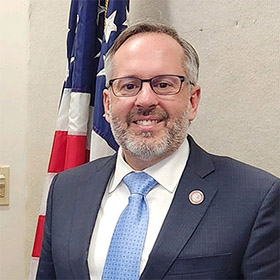
Prior to being appointed by Governor Glenn Youngkin as Director of the Virginia Department of Energy, Glenn Davis represented Virginia’s 84th District in the Virginia House of Delegates from 2014-2023 where he served as Chairman of the House Education Committee and Subcommittee Chairman of the House Appropriations Committee.
Glenn also served as Vice Chairman of the Joint Commission on Technology and Science where he chaired the cyber security and blockchain subcommittees.
Prior to his service in the Virginia General Assembly, Glenn served on the Virginia Beach City Council from 2008-2014.
Professionally, Glenn began his entrepreneurial career out of a one-bedroom apartment when he was 26. In 2007, his telecommunications management firm was named by the Inc. 5000 as one of the 100 fastest growing IT companies in America. After the acquisition of a publicly traded national IT company, Glenn’s company became a national provider of IT and telecom solutions.
Glenn has served as Chairman of Junior Achievement of Greater Hampton Roads, was a founding board member of Green Run Collegiate, a charter school connected to the Green Run community where he grew up and is a past president of the Entrepreneurs’ Organization of Southeast Virginia.
Glenn attended George Mason University, is a graduate of the EO/MIT Entrepreneurial master’s program and the University of Virginia's Sorensen Institute for Political Leadership, and received the Entrepreneurial Excellence Award from the Regent University School of Global Leadership and Entrepreneurship.
About Michael Webb, Ph.D.

Dr. Webb has more than twenty-five years of energy industry experience. Dr. Webb has extensive experience in all aspects of pipeline rate regulation at the Federal and State levels, as well as international levels. He has filed expert testimony in numerous cases involving the calculation of cost-based rates.
He has also prepared several applications for authority to charge market-based rates on interstate oil pipelines. He has filed testimony addressing issues of natural gas pipeline ratemaking and has been qualified as an expert in principles of natural gas rate making.
He has prepared whitepapers and met with FTC Staff to gain approval for mergers on behalf of oil companies. Dr. Webb holds a PhD in economics from George Mason University in Fairfax, Virginia and has published in the journals Public Choice and Natural Gas & Electricity.
His academic interests include applied microeconomics, industrial organization, and auction theory. An Adjunct Professor at GMU, he has taught courses in Law and Economics, the Economics of Regulation, and the Economics of Energy at the graduate and undergraduate level for 16 years.