
In This Story
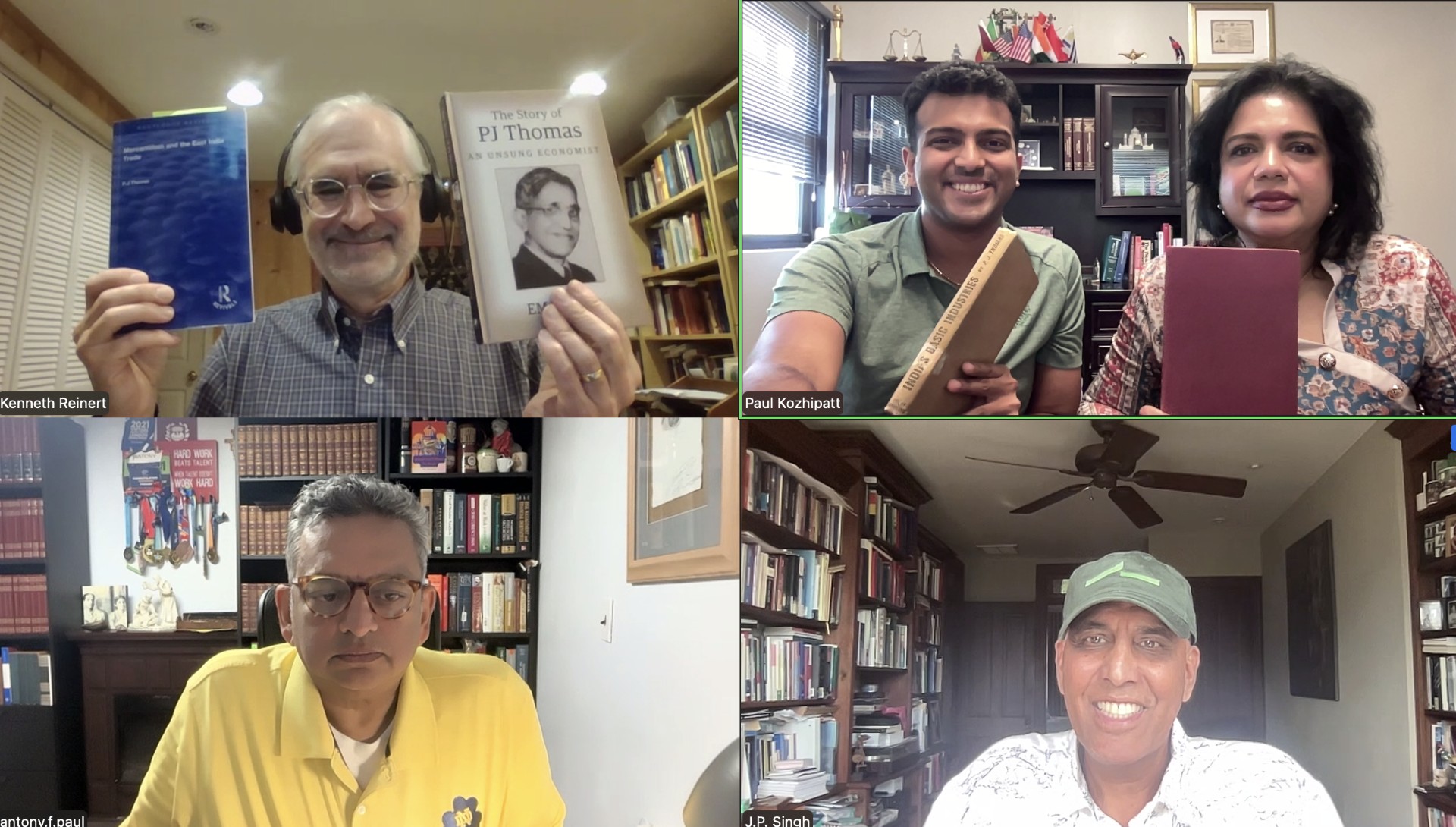
While doing some research on English mercantilism, Global Commerce and Policy (GCP) Professor Kenneth A. Reinert came across occasional references to a book by a P.J. Thomas titled Mercantilism and the East India Trade, published in 1926. Investigating a bit further, Reinert, who teaches in the Schar School of Policy and Government at George Mason University, found that the book had been reprinted in 2019 as part of the Routledge Revivals series and quickly ordered a copy.
Reading Thomas’ Mercantilism and the East India Trade, Reinert encountered an extraordinary history of trade policy in late 17th century and early 18th century England that had many parallels with modern trade policy issues. At the end of the book, he wondered, Who was P.J. Thomas?
There was a biography of P.J. Thomas published in India, because Thomas was an Indian economist. Reinert contacted his GCP colleague, Distinguished University Professor J.P. Singh, who was in India at that time. Upon his return to the Schar School, Singh had a copy of the biography titled The Story of P.J. Thomas: An Unsung Economist.
Unsung indeed. Mercantilism and the East India Trade grew out of Thomas’s undergraduate thesis at Oxford University, where he attended thanks to a modest scholarship. Between 1942 and 1947, Thomas served as an advisor to both the British and independent Indian governments. In this role, he attended the 1944 Bretton Woods Conference—he signed the historic agreement—and he attended the 1945 United Nations conference in San Francisco, signing the original UN Charter.
As if that were not enough, he counted U.S. President John. F. Kennedy as a life-long friend, having met him at the UN conference.
Impressed, and with the encouragement of Singh, Reinert began to write an article about Thomas. Eventually titled “P.J. Thomas’s Scholarship on Mercantilism and the Political Economy of Trade: A Centennial Appreciation and Assessment,” the article was published in Global Perspectives, the University of California Press academic journal where Singh serves as coeditor-in-chief.
End of story? No. Reinert was contacted by Paul Kozhipatt, a recent MBA graduate from the Chicago Booth School. Kozhipatt is the great-grandson of P.J. Thomas, and the family had just celebrated the 60th anniversary of Thomas’s passing. As part of organizing that celebration, the family had discovered the Global Perspectives article.
Reinert and Singh recently met with Kozhipatt and his parents, Tony Kozhipatt and Treasa Kalliath-Kozhipatt, exchanging impressions of an important and, indeed, unsung Indian economist. After a lengthy discussion, the family displayed original copies of P.J. Thomas’s books and all were glad to further acknowledge his important contributions to economic thought.